

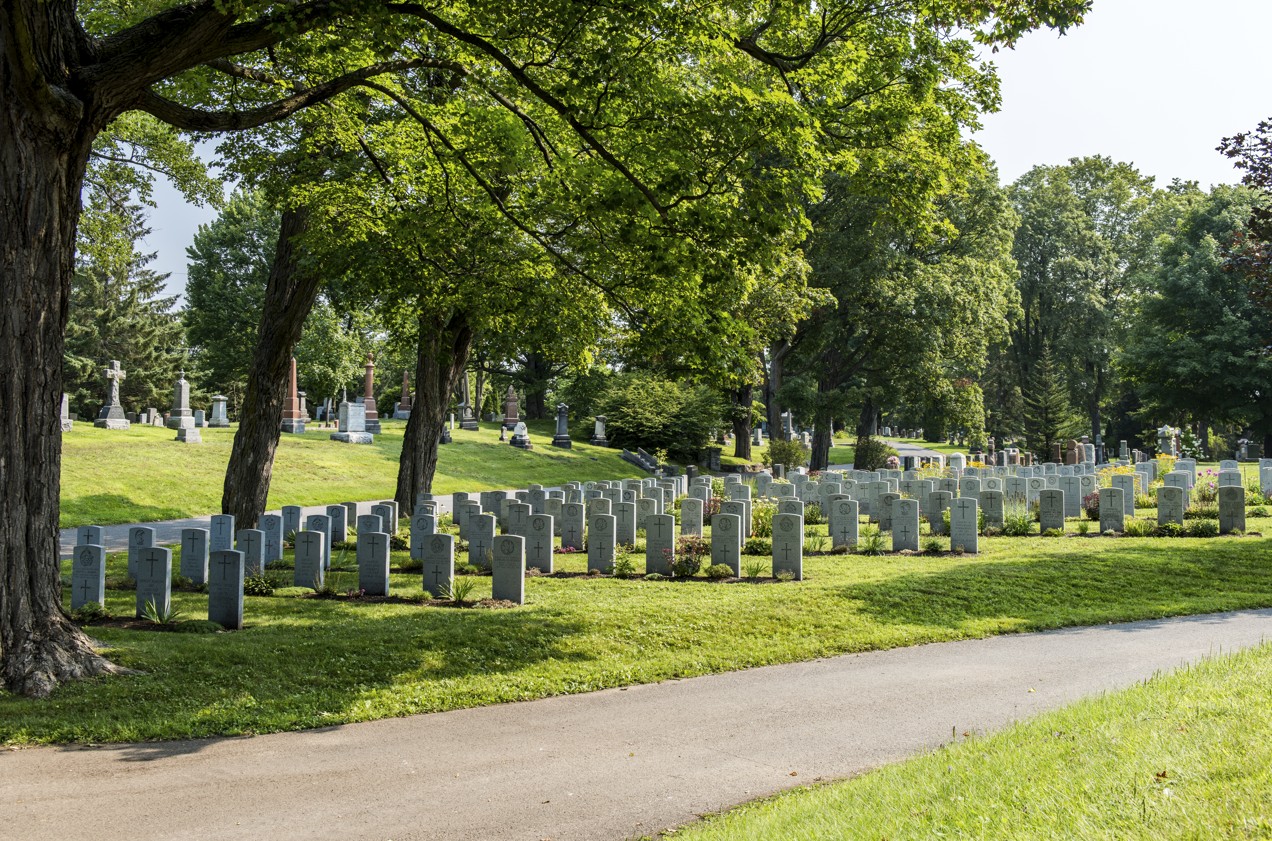
Section 29 of the National Military Cemetery: A Place of Honour and Remembrance
Section 29 stands as one of the oldest and most significant military burial grounds in Canada’s capital. It tells the story of two world wars, the sacrifices made by Canada and its allies, and the enduring commitment to preserve the memory of those who served.
The western part of Section 29 was formally established in 1918 by the Soldiers’ Aid Commission and the Department of Militia and Defence, during the final months of the First World War. Originally created to honour those who died in the conflict, the section soon became the central location for First World War casualties at Beechwood.
In 1922, several war dead who had been buried in single plots throughout the cemetery were respectfully reinterred here, creating a unified space of remembrance. Today, the rows of uniform headstones represent the deep loss felt across Canada, and across the Commonwealth.
A Commonwealth Sacrifice
While many of those buried in Section 29 were Canadian soldiers, the section also includes numerous graves of soldiers from the United Kingdom, Australia, and New Zealand, reflecting the deeply interconnected nature of the Commonwealth war effort. These individuals came from across the globe to fight alongside Canadians. Some were stationed in Canada during the war, others succumbed to wounds sustained overseas, and some were buried here after seeking refuge or receiving treatment in Canada. Their presence at Beechwood is a solemn reminder that the fight for peace crossed oceans and united nations.
Section 29 is primarily known for its First World War burials, but it continued to be used for both veterans and war dead of the Second World War. Generations of servicemen and women are laid to rest here—some who died in combat, others who lived to return home but carried the invisible scars of war for the rest of their lives. Here, one finds the graves of infantry soldiers, pilots, nurses, sailors, and other personnel, each representing a vital link in the chain of service.
Maintained in Perpetuity: The Commonwealth War Graves Commission
A bronze plaque in the heart of Section 29 commemorates the work of the Commonwealth War Graves Commission (CWGC), which ensures that the graves and memorials of Commonwealth war dead are meticulously maintained.
The plaque reads:
“The Commonwealth War Graves Commission was established by Royal Charter of 21 May 1914 and is responsible for the maintenance of graves and memorials in some 150 countries of nearly 1,700,000 members of the Commonwealth who died in the two world wars. It is funded by partner governments in proportion to the war dead in its care—those of Australia, Canada, India, New Zealand, South Africa and the United Kingdom. Newfoundland was a full and equal partner until it entered the Canadian Federation in 1949 and its share was assumed by the Government of Canada. The war dead commemorated here and elsewhere are of many faiths and of none.”
The CWGC's work reflects a shared responsibility across nations. Its presence at Beechwood symbolizes Canada’s continued role in honouring global military heritage and sacrifice. Within Section 29 rest young men barely out of their teens, who died in training accidents or shortly after returning from war.
Some graves bear the names of those who died at home due to war-related illness or injury. Others belonged to decorated veterans, leaders, and caregivers. The diversity of backgrounds, ranks, and regiments offers a powerful narrative of shared sacrifice and duty. Many graves are inscribed with the badges of Commonwealth regiments, their stones aligned in solemn rows. Walking through Section 29 is to walk through a living chapter of our collective history.
Today, Section 29 is more than a military burial ground. It is a space of reflection and education. It serves as a place where Canadians and visitors from around the world, can remember, honour, and learn.
As part of the National Military Cemetery, this section offers a tangible connection to Canada’s past. Whether through commemorative ceremonies, quiet moments of reflection, or visits by families of the fallen, Section 29 continues to serve its mission: ensuring that none who served are ever forgotten.