William Brown Bradley – Section 25, Lot 52N (Mil)
On June 24, 1813, an American force advanced from Fort George toward a British outpost at Beaver Dams on the Niagara Peninsula. The troops expected to launch a surprise attack. Instead, they entered an ambush that ended in one of the most consequential victories of the War of 1812.
Among the British soldiers connected to the American surrender was Captain William Brown Bradley of the 104th (New Brunswick) Regiment of Foot. His presence at Beaver Dams was one episode in a life shaped by revolution, war, migration and settlement, a life that began in the American colonies and ended in Bytown.
Today, Bradley rests at Beechwood Cemetery, where his grave preserves a direct connection to the Battle of Beaver Dams and the defence of Upper Canada.
An American Advance and a Warning
The Battle of Beaver Dams took place during a critical period of the War of 1812. American forces had captured Fort George in May 1813 and were attempting to expand their control of the Niagara Peninsula. After being checked at the Battle of Stoney Creek, they sent a detachment from Fort George to attack the British position at Beaver Dams.
The plan did not remain secret.
Laura Secord, who had learned of the intended attack, undertook her now-famous journey to warn Lieutenant James FitzGibbon. Indigenous scouts were also monitoring the American advance. With advance notice, Kahnawà and Grand River warriors, led by Captains Dominique Ducharme and William Kerr, moved to intercept the approaching troops.
On June 24, the American column entered heavily wooded terrain near Beaver Dams. Indigenous warriors attacked from the surrounding woods, gradually encircling and exhausting the American force. Their leadership, knowledge of the landscape and sustained pressure determined the outcome of the engagement.
FitzGibbon later approached the American commander under a flag of truce and demanded his surrender. British reinforcements, including a detachment of the 104th Regiment, were present as the American force capitulated. Bradley was among the soldiers associated with this detachment and the surrender.
The victory belonged overwhelmingly to the Indigenous warriors who fought the battle. Their decisive role was too often minimized in later popular accounts, which centred almost exclusively on Secord and FitzGibbon. The full history of Beaver Dams requires recognition that Kahnawà and Grand River warriors confronted and defeated the advancing American force.
The result had significant strategic consequences. The American defeat helped leave the British in control of the Niagara region for the remainder of 1813 and discouraged further American movement beyond Fort George.
Bradley’s Road to Beaver Dams
For Bradley, the struggle against the American invasion was deeply connected to his family’s past.
He grew up on Whitemarsh Island near Savannah, Georgia, during the American Revolution. His parents attempted to maintain their plantation while raising Bradley, his twin brother and their sister amid the upheaval in the Thirteen Colonies. His father, who worked for the British Army Commissariat, died during the war.
In 1781, Bradley’s mother married Lieutenant John Jenkins, a professional soldier with the New Jersey Volunteers. When the Revolution ended, Loyalists faced displacement and confiscation. Jenkins moved the family north to New Brunswick, where they joined thousands of others attempting to rebuild their lives under the Crown.
The family established a farm and a large estate near Fredericton. Four more children were born there, and the Bradleys and Jenkinses became part of a new Loyalist society taking shape in the colony.
In 1793, Jenkins and Bradley joined the militia of the King’s New Brunswick Regiment. Britain was at war with revolutionary France, and colonists feared that the young American republic might take advantage of the wider conflict to invade the Maritimes.
Bradley went on to serve in two additional regiments. He rose from ensign to captain in the 104th Regiment of Foot, serving alongside one of his half-brothers.
The Winter March of the 104th
When the United States declared war on Britain in 1812, Captain Bradley was commanding a company of the 104th Regiment in New Brunswick.
By early 1813, British commander-in-chief Sir George Prevost feared that Upper Canada did not have enough troops to withstand further American attacks. The 104th was ordered to undertake an extraordinary winter march from Fredericton to Quebec City and onward to Kingston, a journey of approximately 1,125 kilometres.
Bradley’s company was among the six companies that completed the overland trek in February and March. Over 52 days, 554 officers and soldiers moved through severe cold and deep snow while transporting the supplies required to continue their service.
The march remains one of the great feats of endurance in Canadian military history. It also positioned the 104th to support British operations in Upper Canada during the most dangerous year of the war.
Bradley’s wartime service extended beyond Beaver Dams. His obituary reported that he participated in the May 29, 1813 attack on Sackets Harbor, the important American naval and shipbuilding base on Lake Ontario, where his company suffered casualties. In August 1814, he took part in the assault on American-occupied Fort Erie, where his company again sustained losses.
Beaver Dams, however, stands apart. It was a decisive reversal for the invading force and an enduring example of the essential role Indigenous allies played in defending Upper Canada.
From Soldier to Settler
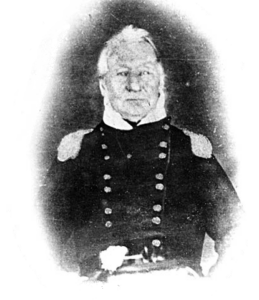
After the War of 1812 and the defeat of Napoleon in Europe, Britain reduced the size of its army. The 104th Regiment was disbanded, and Bradley retired on half-pay at approximately 46 years of age. He initially lived near Montreal before members of the family moved again, this time to the developing Bytown area.
Bradley received land grants in March and Huntley townships and along the Rideau River. His military experience and leadership skills soon found new purpose. He served as lieutenant-colonel of the First Carleton Militia and as a justice of the peace for the new judicial district of March and Huntley.
Among his neighbours, Bradley was remembered as “generous, good-hearted and obliging.” He and his sons operated a wool-carding mill and a shingle mill while maintaining a farm with livestock. Like many Loyalist soldiers, he helped transform military service and land grants into the foundations of a growing community.
When Bradley died in Bytown on October 2, 1850, he was remembered as “not only a brave officer but a deserving settler” of Carleton County.
A Battlefield Legacy at Beechwood
Bradley was first buried in the Sandy Hill cemetery, where his son Edward Sands Bradley had been interred in 1836. When th
e Sandy Hill burial grounds closed, the remains of eight members of the Bradley family were transferred in 1876 to the newly opened Beechwood Cemetery.
Captain William Brown Bradley now rests in Section 25, Lot 52N.
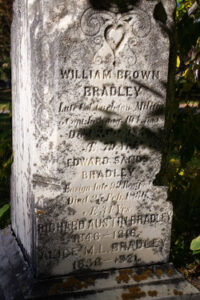
His story connects Beechwood to the Battle of Beaver Dams, but it also reveals the wider human movement behind the War of 1812. Bradley experienced the American Revolution as the child of a Loyalist family, helped defend British North America as an officer and then contributed to the civic and economic development of the Bytown region.
The Battle of Beaver Dams is remembered for warning, intelligence and surrender. Above all, it must be remembered as an Indigenous victory. Bradley’s presence there places him within that larger history and reminds us that every military grave can open a path to a more complete understanding of the people, alliances and sacrifices that shaped Canada.
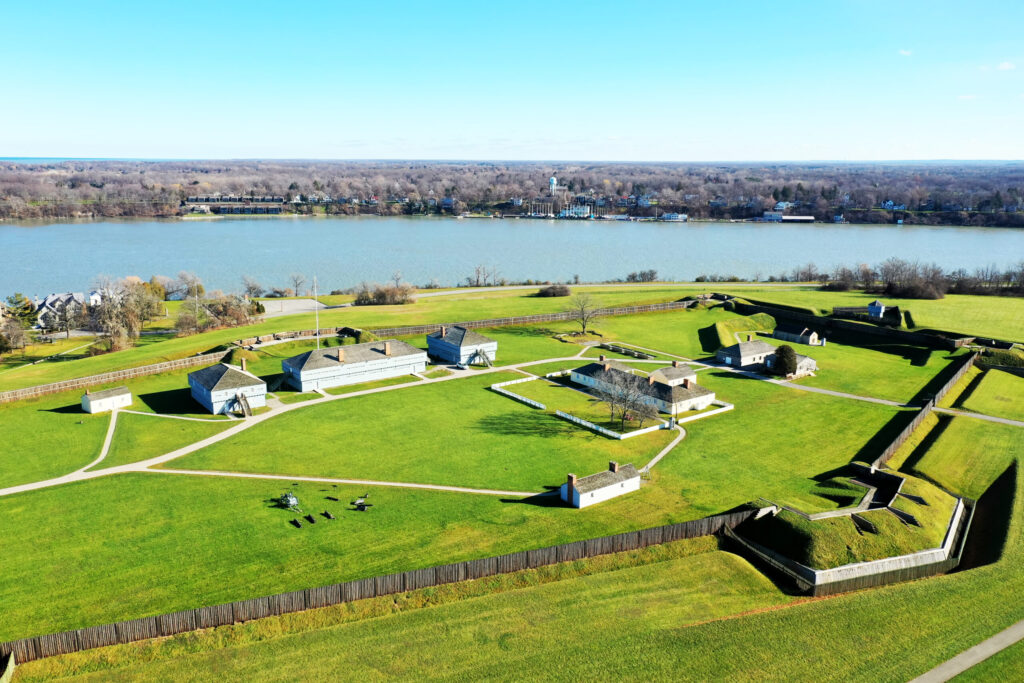
Title image: Aerial view of historic Fort George National Historic Site in Niagara-on-the-Lake, Ontario, Canada. Opened in 1802 (iStock photo ID:1370146450)