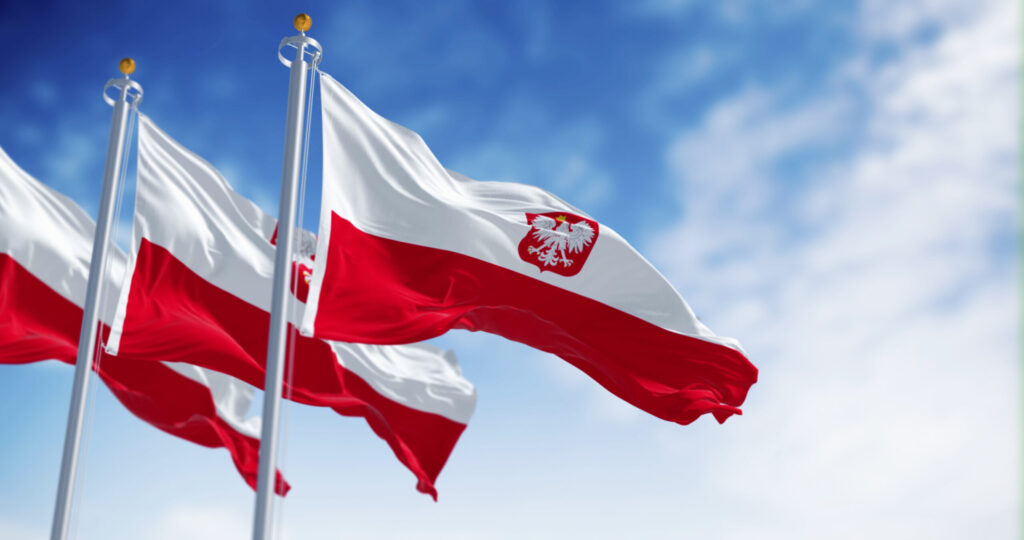
Among those laid to rest at Beechwood Cemetery are veterans whose lives connect Canada to some of the defining events of the Second World War. Major Stanisław Tarazewicz was one of them.
A soldier of the Polish underground and the Polish II Corps, a survivor of Soviet imprisonment and a veteran of the Italian Campaign, Tarazewicz was decorated for extraordinary courage during the Battle of Monte Cassino. He later built a new life in Canada, contributed his technical expertise to major Canadian projects and became an active leader within Ottawa’s Polish veterans’ community.
His grave in Section 110 at Beechwood preserves the memory of a remarkable journey shaped by service, exile, resilience and an enduring devotion to Poland. Poland’s official register of veterans’ graves identifies him as a soldier of the Polish underground and the Polish II Corps in the West.
From occupied Poland to the underground resistance
Stanisław Tarazewicz was born on January 22, 1922, in Budsław, in the Wilno region of pre-war Poland. At the age of 14, he moved to Wilno—now Vilnius, Lithuania—to study roads and hydraulic engineering at a technical school.
His life changed dramatically in September 1939. Germany invaded Poland on September 1, followed by the Soviet invasion from the east on September 17. Tarazewicz volunteered for a locally organized Polish formation, but after Wilno came under Lithuanian control, he was arrested and interned for approximately 10 months.
After escaping, he returned to Wilno and joined the Polish underground resistance. He served as the leader of a small cell under the code name “Mały,” meaning “Shorty.” When members of his cell were arrested, he went into hiding. In the spring of 1941, he was captured by the Soviet secret police and deported without trial to a labour camp in northern Russia.
Following Germany’s invasion of the Soviet Union and the subsequent Polish-Soviet agreement, Polish citizens held in the Soviet Union were released and a Polish army began to form. Tarazewicz travelled across the Soviet Union and enlisted with the Polish 5th Division in September 1941. Institute of National Remembrance
A sapper with the Polish II Corps
In 1942, Tarazewicz left the Soviet Union with the Polish forces that would become part of General Władysław Anders’ Polish II Corps. He completed officer-cadet training as a sapper and was assigned to the 2nd Company of the 10th Sapper Battalion.
Sappers—military engineers—carried out some of the most dangerous and technically demanding work on the battlefield. They cleared mines, opened routes through obstacles, constructed roads and bridges, and enabled infantry and armoured units to advance. Their work required precision and discipline, often while exposed to direct enemy fire.
After training in Iraq, Palestine, Lebanon and Egypt, Tarazewicz and his unit arrived in Italy in early 1944. He served throughout the Polish II Corps’ Italian Campaign, including operations along the Sangro River, the Battle of Monte Cassino, the advance along the Adriatic, fighting in the Apennines, the defence of the Senio River and the final campaign for Bologna.
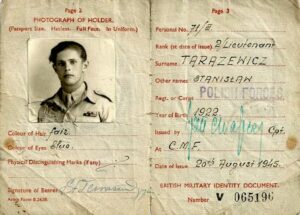
Second Lieutenant Stanisław Tarazewicz, recipient of the Monte Cassino Cross, No. 39565.
Courage at Monte Cassino
Monte Cassino was one of the most difficult and strategically important battles of the Italian Campaign. German forces occupied heavily defended mountain positions anchoring the Gustav Line and blocking the Allied route toward Rome. After months of costly fighting, British and Polish forces finally broke the line and captured Cassino on May 18, 1944. Department of National Defence
Tarazewicz played a direct role in that victory. On May 17, he and his fellow sappers supported Polish tanks advancing toward Phantom Ridge, known in Polish as Widmo. Working under concentrated German artillery fire, they cleared mines and opened a route that allowed the tanks to reach the summit. Tarazewicz was wounded repeatedly during the assault but continued to carry out his duty.
For his courage, he received the Silver Cross, Class V, of the War Order of Virtuti Militari.
The Virtuti Militari
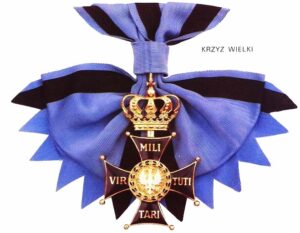
Grand Cross of Virtuti Militari Order, Poland. The Highest Military Order in Poland. Grand Cross (Ist of Order) Official Pattern
Established by King Stanisław August Poniatowski in 1792, the Virtuti Militari is Poland’s highest military decoration for courage and distinguished service in war. Its Latin name means “For Military Virtue,” and its motto, “Honor i Ojczyzna,” means “Honour and Fatherland.” It is also one of the oldest military decorations in the world.
The order has five classes: the Grand Cross, Commander’s Cross, Knight’s Cross, Golden Cross and Silver Cross. Although designated Class V, the Silver Cross recognizes exceptional personal bravery in the face of the enemy. Its significance is often compared to that of the Victoria Cross within the Commonwealth. Virtuti Militari overview
Tarazewicz received his Silver Cross in August 1944 from General Kazimierz Sosnkowski, Commander-in-Chief of the Polish Armed Forces. The decoration recognized not only a single courageous act, but the discipline, sacrifice and sense of responsibility required to clear a path forward while under fire.
His other decorations included the Monte Cassino Cross, the Polish Army Medal, the War Medal 1939–1945, the Italy Star, the 1939 September Campaign Cross and the Home Army Cross.
Building a new life in Canada
Tarazewicz was commissioned as an officer in April 1945. Following the capture of Bologna, he was transferred to the 20th Sapper Battalion as the commander of a road-construction platoon. He relocated to the United Kingdom with the Polish II Corps in 1946 and was demobilized in 1949.
In Britain, he worked as an industrial draftsman and remained active in Polish cultural and veterans’ organizations. He married Teresa Oczepko in 1955, and the couple immigrated to Canada that same year, settling first in Montreal.
Tarazewicz brought the skills of an engineer and problem-solver to his new country. His career included work with Shawinigan Water and Power Corporation, Atomic Energy of Canada, General Engineering Company and Canada Cement Lafarge. He also contributed to the design of Montreal’s Louis-Hippolyte-La Fontaine Tunnel beneath the St. Lawrence River.
In 1987, Stanisław and Teresa moved to Dunrobin, near Ottawa. He became active in Branch No. 8 of the Polish Combatants’ Association in Canada and served as its president from 1995 to 1997. He was promoted to captain in 2000 and to major in 2010 in recognition of his wartime service.
Major Stanisław Tarazewicz died in 2013 at the age of 91. He is buried in Section 110 at Beechwood Cemetery.
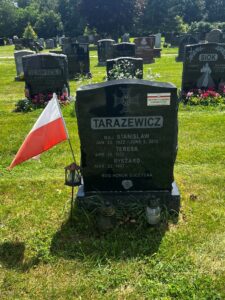
A legacy preserved at Beechwood
Major Tarazewicz’s story reflects the experience of a generation forced from its homeland by war and political oppression. He endured occupation, imprisonment and exile, fought for freedom in one of the Second World War’s most demanding campaigns, and then helped build the country that became his home.
At Beechwood, his grave is both a place of personal remembrance and part of a larger national story. It reminds visitors that Canada’s history is enriched by those who arrived carrying memories of service and sacrifice from around the world.
The Virtuti Militari recognized Stanisław Tarazewicz’s courage on the battlefield. His life after the war demonstrated another form of service: building, contributing, leading and ensuring that the sacrifices of Polish veterans would not be forgotten.
Reference:
Polish Exiles of World War II. “Stanisław Tarazewicz: Polish Veteran of the Battle of Monte Cassino and Recipient of the Virtuti Militari.” Based on a memoir authorized by Major Stanisław Tarazewicz and written by Dr. Jan Z. Galuszka. Accessed August 12, 2026.
https://www.polishexilesofww2.org/stanislaw-tarazewicz
Polish Combatants’ Association in Canada, Branch No. 8 in Ottawa. “Polish Combatants’ Association People.” Includes a link to the memoirs of Major Stanisław Tarazewicz. Accessed August 12, 2026.
https://www.spkottawa.ca/english/spk_people.html
“Virtuti Militari.” Wikipedia. Background information on the history, classes and significance of Poland’s highest military decoration. Accessed August 12, 2026.
https://en.wikipedia.org/wiki/Virtuti_Militari
Photo source: War Relics Forum, “Monte Cassino Cross,” page 19, posted by andrzejku98 on March 20, 2014. Accessed August 12, 2026.
https://www.warrelics.eu/forum/polish-armed-forces-west-polskie-si-y-zbrojne-na-zachodzie-1939-1947/monte-cassino-cross-26547-19/