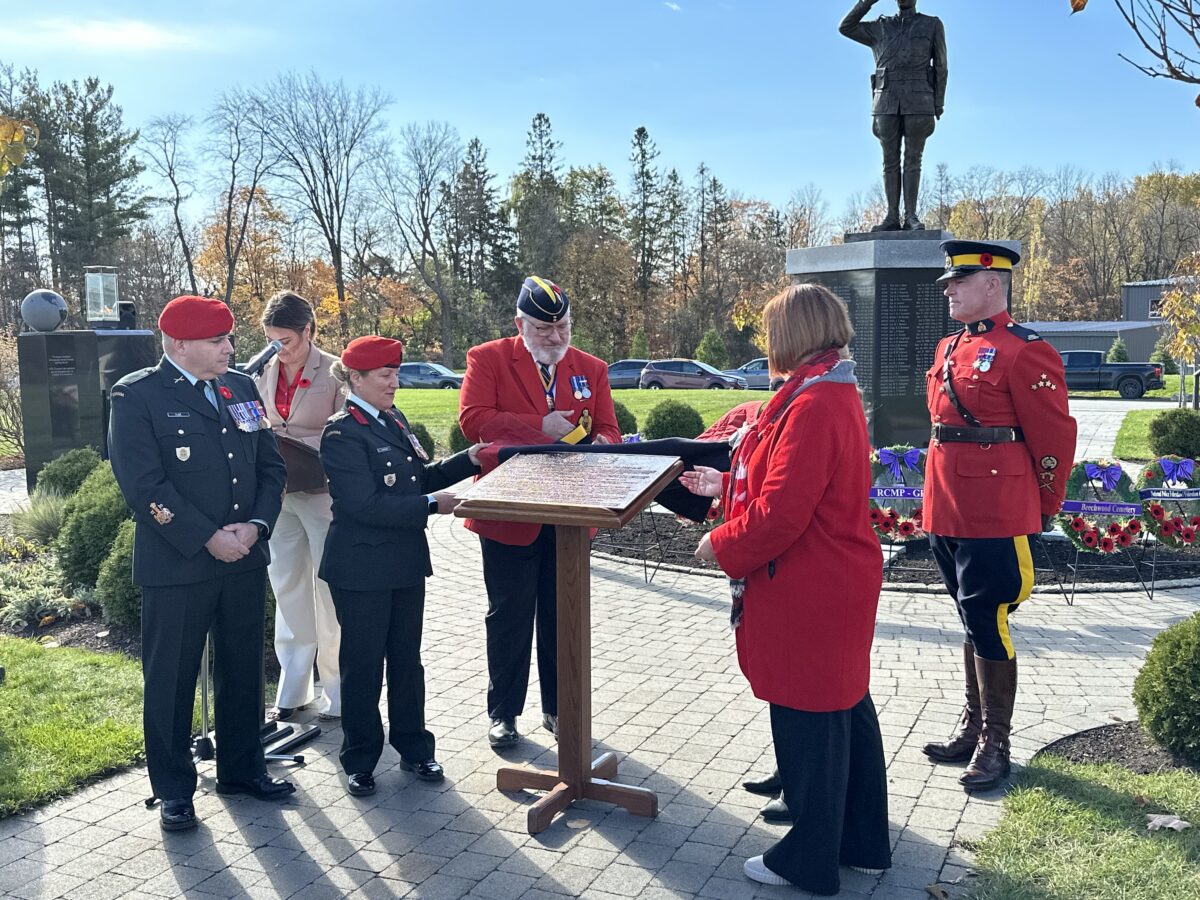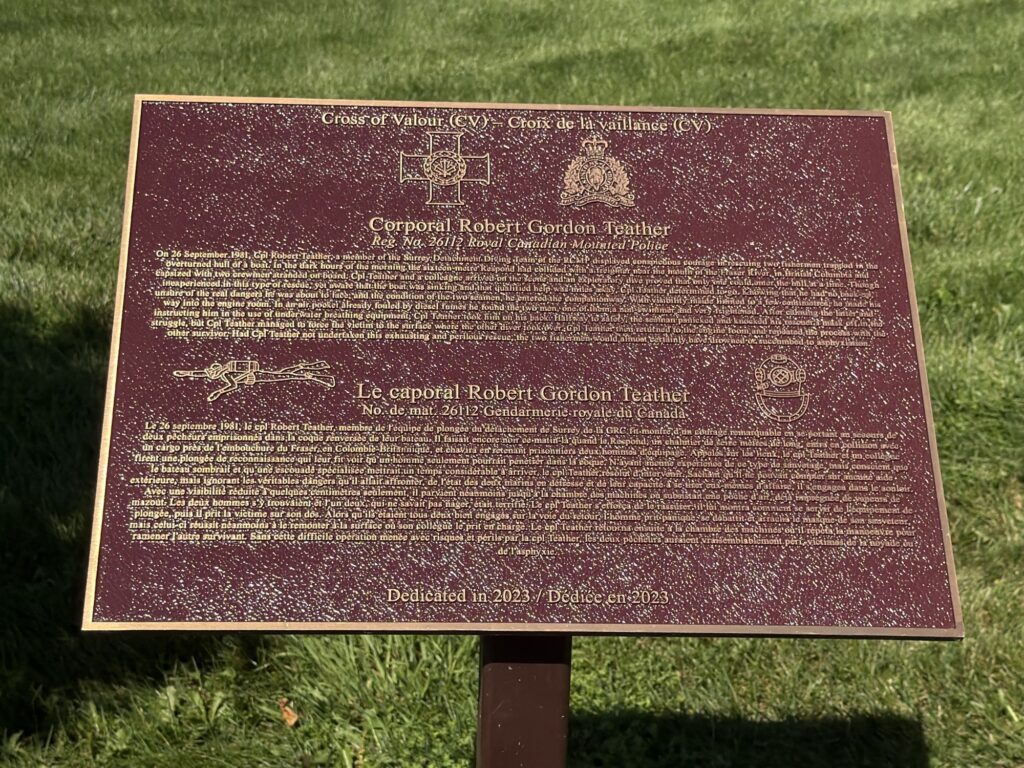
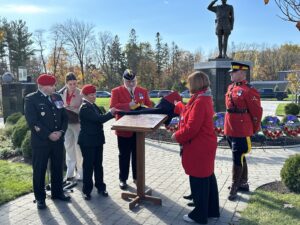
On November 8, 2023, a commemorative plaque honouring Corporal Robert Gordon Teather, C.V., Regimental Number 26112, was unveiled at the RCMP National Memorial Cemetery at Beechwood.
The plaque preserves the story of an extraordinary rescue and recognizes a member of the Royal Canadian Mounted Police whose courage saved two lives. It also ensures that future generations can learn about a moment when duty, training and selflessness were tested under the most dangerous conditions.
Corporal Teather remains the only member of the RCMP to have received the Cross of Valour, Canada’s highest decoration for bravery.
The Cross of Valour
Established in 1972, the Cross of Valour recognizes “acts of the most conspicuous courage in circumstances of extreme peril.” It is the highest of Canada’s three Decorations for Bravery.
The decoration takes the form of a gold cross with four equal limbs. Its red-enamelled face bears a gold maple leaf surrounded by a laurel wreath. On the reverse appear the Royal Cypher and the words “VALOUR” and “VAILLANCE.”
The Cross of Valour is reserved for exceptional situations in which an individual knowingly places their own life at extreme risk to protect or rescue another person. Learn more about the Cross of Valour through the Office of the Governor General of Canada.
For Corporal Teather, that moment came in the darkness beneath an overturned fishing vessel.
A Collision on the Fraser River
During the early morning hours of September 26, 1981, the 16-metre fishing vessel Respond collided with a freighter near the mouth of the Fraser River in British Columbia.
The force of the collision caused the fishing vessel to capsize. Two crew members remained trapped inside its overturned hull.
Corporal Teather was then serving with the Surrey Detachment Diving Team of the RCMP. He and another diver arrived at the scene and conducted an exploratory dive. They quickly determined that the confined passage into the vessel was too narrow for more than one diver to enter at a time.
The situation was deteriorating.
The vessel was sinking. Specialized assistance was still some distance away. No one knew how long the remaining air pocket inside the hull would last or whether the two trapped fishermen could survive the fumes accumulating around them.
Corporal Teather understood that entering the vessel alone would expose him to serious risks. He would have no diver immediately behind him. He did not know the internal condition of the damaged vessel, the location of the fishermen or what obstacles might block his escape.
Despite these dangers, he made the decision to enter.
Into the Overturned Vessel
Corporal Teather passed through the companionway and began moving through the capsized vessel.
Visibility inside was limited to only a few centimetres. In the darkness, he was forced to rely largely on touch as he navigated toward the engine room. Twisted equipment, damaged structures and shifting debris could have trapped him at any moment.
When he reached the engine room, he found the two fishermen inside a small pocket of air already contaminated by diesel fumes. One of the men could not swim and was terrified.
Corporal Teather first worked to calm him. He explained how to use the underwater breathing equipment and then positioned the fisherman on his back for the journey out of the vessel.
Partway to safety, the fisherman panicked.
During the struggle, he knocked Corporal Teather’s diving mask from his face. In the darkness and confined space, Corporal Teather was now attempting to control a frightened man while also trying to restore his own ability to see and breathe.
He maintained control of the situation and forced his way toward the surface. Once outside the vessel, the second diver took charge of the rescued fisherman.
Corporal Teather could have remained at the surface. He was already exhausted and had narrowly escaped becoming trapped himself.
Instead, he immediately returned to the overturned vessel.
He retraced the same dangerous route through the darkness, reached the engine room and brought the second fisherman to safety.
Without his intervention, both men would almost certainly have drowned or died from asphyxiation.
National Recognition
Corporal Teather’s actions represented courage in its clearest form. He understood the danger, knew that he would be entering the vessel without immediate backup and still chose to place the lives of two strangers ahead of his own safety.
He was awarded the Cross of Valour on April 25, 1983, and formally invested on June 24, 1983. His official citation recognizes the exhausting and perilous nature of the rescue and the certainty that the fishermen would otherwise have died. Read Corporal Teather’s official Cross of Valour citation.
The decoration did not define Corporal Teather’s entire career, but it reflected the qualities that shaped his service: professionalism, determination, technical skill and concern for others.
Born in Hamilton, Ontario, in 1947, Robert Gordon Teather joined the RCMP in September 1967. He spent his career in British Columbia’s “E” Division and served in several demanding roles, including uniformed patrol, underwater operations and crisis negotiation.
He became a diver and diving instructor and helped advance professional underwater policing. His knowledge was shared with police officers, firefighters, physicians and other specialists in Canada and the United States. He also wrote about RCMP history and underwater investigations, helping to pass his experience to future generations.
Corporal Teather retired from the RCMP in 1998. He died in Surrey, British Columbia, on November 15, 2004, at the age of 57.
A Permanent Place in the RCMP Story
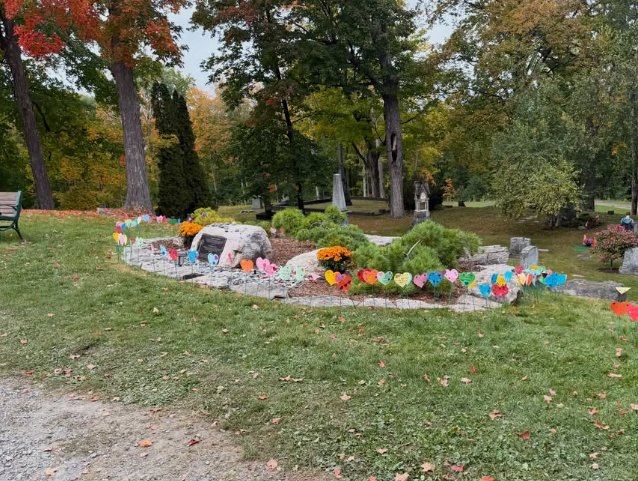
The unveiling of Corporal Teather’s plaque at Beechwood created a permanent place where his story can be encountered, understood and remembered.
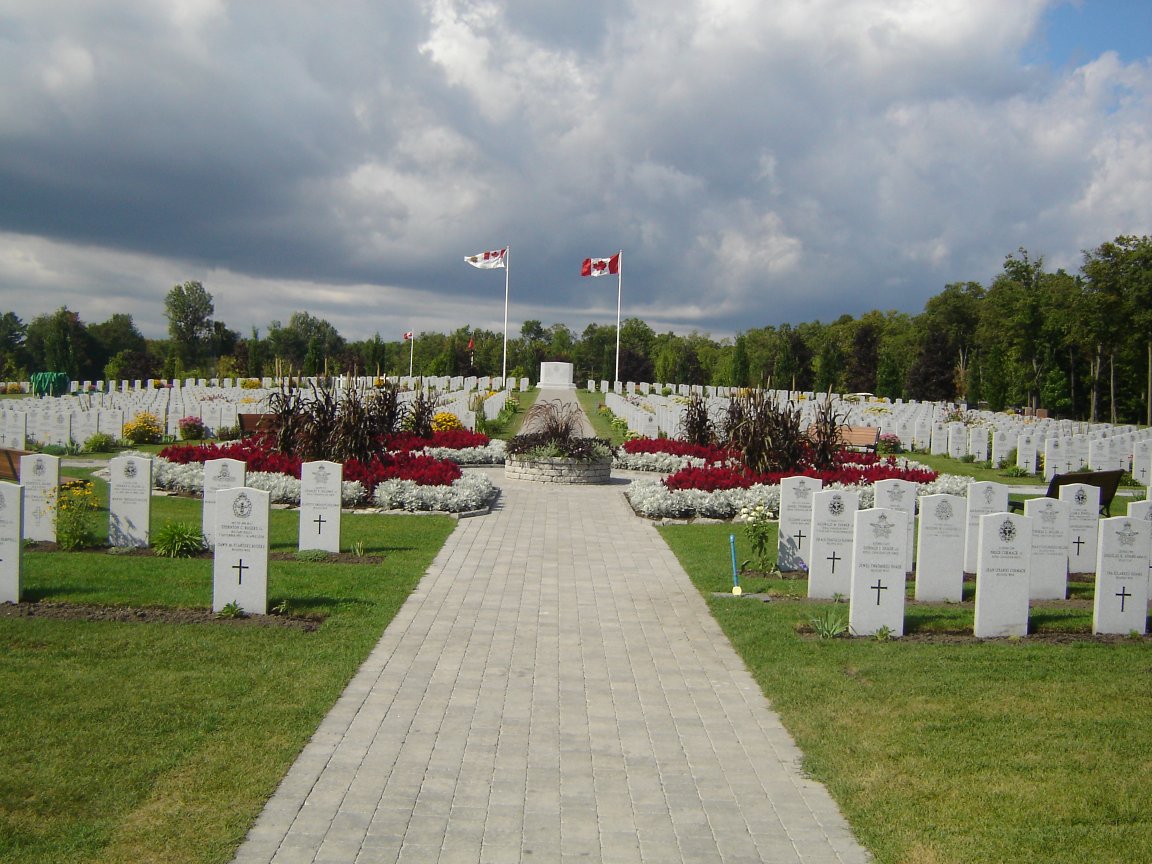
The plaque forms part of the commemorative landscape of the RCMP National Memorial Cemetery. This national site honours the service of members, Veterans, employees and families connected to the RCMP while helping visitors understand the Force’s history and its role in Canada.
Memorial plaques do more than record names and dates. They connect individual lives with the broader history of an institution and a country. They transform an act known to one generation into a lesson that can be carried forward by the next.
Corporal Teather’s story is not simply about fearlessness. Courage does not require the absence of fear or uncertainty. It is the decision to act despite them.
In the darkness beneath the Respond, Corporal Teather faced confined spaces, contaminated air, almost no visibility and the possibility that the sinking vessel could become his own tomb. He entered because two people needed help. After rescuing the first, he returned because another life remained in danger.
The plaque unveiled in 2023 ensures that this decision will not be forgotten.
Visitors who stop before it are invited to reflect on the meaning of service and the responsibilities carried by those who wear the RCMP uniform. They are also reminded that extraordinary courage can emerge without warning, in a moment when one person must decide whether to step forward for another.
Corporal Robert Gordon Teather stepped forward.
Two men lived because he did.
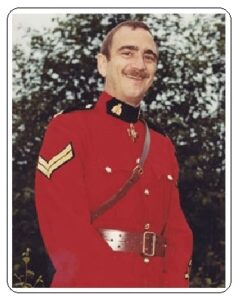
Photo: Corporal Robert Gordon Teather, C.V., Regimental No. 26112. Source: RCMP Graves, “Vet of the Month,” June 2010.