The South African War of 1899–1902 marked an important and complex chapter in Canadian history. It was the first conflict in which Canada officially sent troops overseas and one of the earliest occasions when members of the North-West Mounted Police served in large numbers beyond Canada.
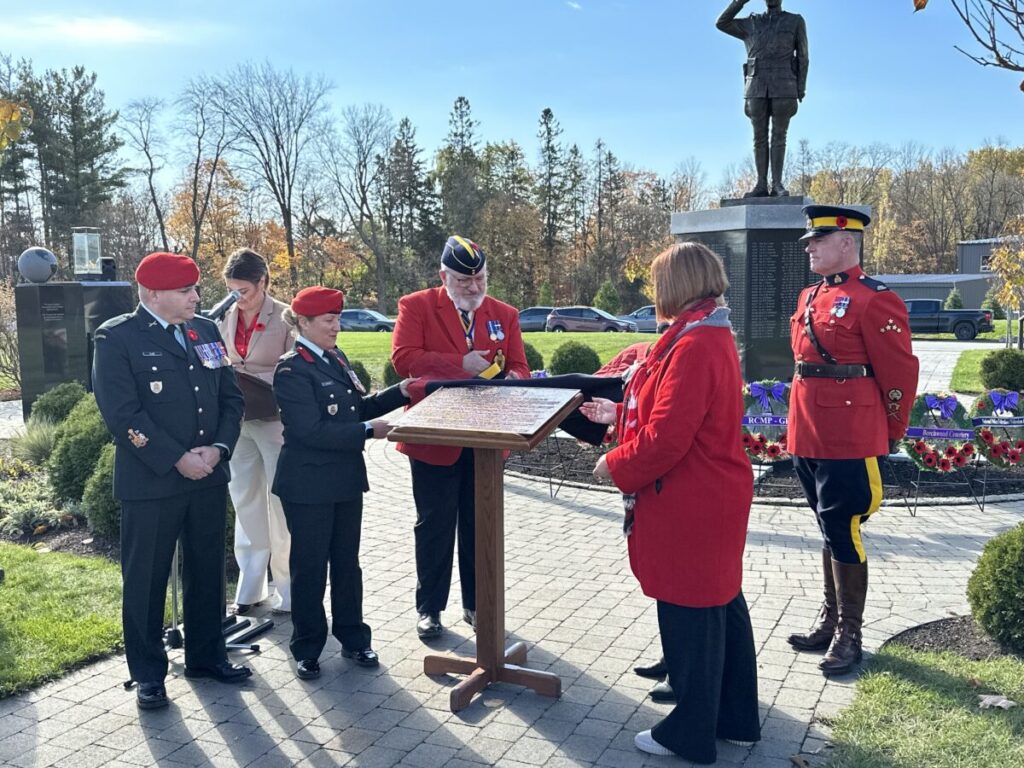
At the RCMP National Memorial Cemetery at Beechwood, a commemorative plaque now ensures that this chapter of the Force’s history and the service of those who participated, is remembered.
Canada’s First Overseas Conflict
The South African War grew from decades of tension between the British Empire and the Boer republics of the Transvaal and the Orange Free State.
Canada’s participation generated considerable debate. Some Canadians believed the country should support Britain, while others opposed involvement in what they viewed as an imperial war. Despite this division, more than 7,000 Canadians volunteered. Approximately 280 lost their lives, many because of disease, injury and the severe conditions in which they served.
The conflict became Canada’s first major military expedition overseas and established precedents that would influence the country’s military development during the 20th century.
Mounted Experience for a Mounted War
The conditions in South Africa placed a premium on mobility, horsemanship, reconnaissance and the ability to operate across large and difficult landscapes.
These were skills that members of the North-West Mounted Police had developed through their work across the Canadian Prairies and the North. At the time, the Force could provide more trained mounted personnel than Canada’s small regular army.
The plaque at the RCMP National Memorial Cemetery records that, from a total strength of approximately 900, the North-West Mounted Police granted leave to 290 officers and members to serve in South Africa. They were accompanied by 155 horses.
Members served with several Canadian and imperial formations, including:
- The 1st Battalion, Canadian Mounted Rifles, commanded initially by North-West Mounted Police Commissioner Lawrence W. Herchmer
- The 2nd and 5th Battalions of Canadian Mounted Rifles
- Strathcona’s Horse, commanded by Superintendent Samuel Benfield Steele
- The South African Constabulary
The North-West Mounted Police had a particularly significant influence on the 1st Battalion, Canadian Mounted Rifles. Police members filled 13 of its 20 officer positions and represented approximately 40 per cent of its other ranks. Recruited largely through Mounted Police posts in Western Canada, the battalion earned a reputation for effective and aggressive scouting during its operations. Learn more from the Canadian War Museum.
Commissioner Herchmer and the Canadian Mounted Rifles
Commissioner Lawrence Herchmer offered to raise a unit composed of experienced police members, former members and skilled horsemen from Western Canada.
The resulting mounted rifle battalion arrived in Cape Town in February 1900. It participated in operations in the western Cape Colony before joining the advance toward Pretoria and beyond.
The unit’s experience demonstrated how effectively the skills developed by the North-West Mounted Police could be adapted to military service. Its members understood horses, long-distance movement, independent operations and reconnaissance. These abilities made them valuable in a conflict fought across the vast South African veld.
Sam Steele and Strathcona’s Horse
One of the best-known figures connecting the North-West Mounted Police to the war was Superintendent Sam Steele.
Steele had joined the Force in 1873 and had already served during the North-West Resistance of 1885 and the Klondike Gold Rush. When Lord Strathcona offered to raise and finance a mounted regiment for service in South Africa, Steele was selected to command it.
Although formally part of the British Army, Strathcona’s Horse was recruited entirely in Western Canada. Its ranks included serving and former members of the North-West Mounted Police.
The regiment arrived in Cape Town in April 1900 and later joined General Redvers Buller’s Natal Field Force. It participated in difficult operations against Boer forces in Natal and the Transvaal, earning recognition for its mobility, endurance and effectiveness.
After returning the regiment to Canada, Steele went back to South Africa and served with the South African Constabulary, the paramilitary organization created to police the conquered Boer republics.
Sergeant Arthur Richardson, Victoria Cross
Among the members of Strathcona’s Horse was Sergeant Arthur Herbert Lindsay Richardson of the North-West Mounted Police.
On July 5, 1900, at Wolve Spruit, Richardson’s small party came under heavy enemy fire. During the withdrawal, he saw that a Canadian trooper had been wounded and that the man’s horse had been shot.
Richardson turned back. Riding a wounded horse and exposed to intense crossfire, he reached the injured trooper, lifted him onto his own mount and carried him to safety.
For this act of conspicuous gallantry, Richardson was awarded the Victoria Cross, the highest award for military valour. He remains the only serving member of the Force to have received the Victoria Cross.
A Force Willing to Serve
The willingness of Mounted Police members to volunteer was captured by Commissioner A. Bowen Perry in the Force’s annual report of December 20, 1900:
“The North-west Mounted Police are well and favourably known beyond the bounds of Canada, and I would like that it had been known to the world as one of the corps which had taken part in the great South Africa War. With but a few exceptions all ranks were willing to go, and it was not a question of who would go, but who must stay at home.”
His words illustrate the scale of the response within a Force that still had significant policing responsibilities across an enormous Canadian territory.
The members who remained in Canada also performed essential service. Releasing hundreds of trained personnel placed considerable pressure on the organization at a time when it was responsible for maintaining law and order across the West and the Yukon.
Remembering the Complete History
Remembering the service and courage of individual members does not require simplifying the conflict in which they served.
The South African War was an imperial struggle that deeply divided Canadian opinion. It also caused widespread destruction and severe suffering among Boer and Black South African civilians.
Commemoration provides an opportunity to examine this complete history. It allows us to recognize individual bravery while continuing to study the political decisions, military practices and human consequences surrounding the conflict.
This is one of the central purposes of the RCMP National Memorial Cemetery: to preserve stories of service while creating space for reflection, education and a deeper understanding of Canada’s past.
Unveiling the Plaque at Beechwood
On Sunday, November 5, 2023, the RCMP Veterans’ Association, Ottawa Division, unveiled the bilingual plaque honouring the North-West Mounted Police members who served during the South African War.
The plaque was unveiled by Marie-France Lalonde, Member of Parliament for Orléans and Parliamentary Secretary to the Minister of National Defence; Colonel Hanrahan; Chief Warrant Officer Dubé; Tanya Mirsky and Staff Sergeant Major Rozon of the RCMP; and Wayne Jacquard, President of the RCMP Veterans’ Association, Ottawa Division.
Watch the plaque unveiling ceremony.
A Lasting Place of Remembrance
The plaque connects the modern RCMP with the earlier North-West Mounted Police and with a period when the Force’s mounted traditions, leadership and frontier experience were tested far from Canada.
It also gives visitors a place to learn about Commissioner Herchmer, Superintendent Sam Steele, Sergeant Arthur Richardson and the hundreds of Mounted Police members who stepped away from their regular duties to serve overseas.
At the RCMP National Memorial Cemetery, their history is preserved not simply as a record of war, but as part of the continuing story of service, sacrifice and duty that has shaped the Force for more than 150 years.
By telling these stories, Beechwood and the RCMP Veterans’ Association ensure that remembrance remains an active commitment, one grounded in recognition, education and an honest engagement with the past.