Walk through an older section of almost any historic cemetery and you will quickly notice something unusual carved into the stones. A skull with wings. An hourglass with sand running out. A candle that has just been extinguished. To modern eyes, these images can appear stark or even unsettling.
Yet for the generations who created them, these symbols carried a clear and purposeful message.
They belong to a long artistic tradition known as memento mori, a Latin phrase meaning “remember that you must die.” Far from being macabre decoration, these carvings served as reminders for the living and encouraging reflection on the brevity of life and the importance of how one chooses to live it.
For centuries, cemeteries were not only places of burial. They were also landscapes of reflection, where stone markers quietly spoke to those who passed among them.
The concept behind memento mori reaches back to the philosophical traditions of ancient Greece and Rome. Philosophers and ancient thinkers often encouraged people to reflect on death regularly. Their reasoning was straightforward: awareness of mortality sharpened one’s priorities and helped cultivate virtue.
When Christianity spread across Europe, this idea took on a spiritual dimension. The awareness of death became closely tied to the preparation of the soul and the belief that earthly life was only a brief stage in a much larger journey.
By the late Middle Ages, reminders of mortality were widely present in religious art and architecture. Paintings and sculptures depicted skeletons, decomposing bodies, and scenes such as the Danse Macabre, a symbolic “dance of death” showing individuals from every social class being led to the grave.
These images reflected a society deeply aware of life’s fragility, especially after the devastation of the Black Death. Mortality was not hidden away. It was acknowledged openly and incorporated into everyday life.
When burial practices expanded into formal cemeteries, this visual language followed.
Between the seventeenth and eighteenth centuries, particularly in Europe and colonial North America, gravestones frequently carried symbols associated with memento mori. These carvings were not meant to frighten visitors. Instead, they were meant to remind them of life’s limited time.
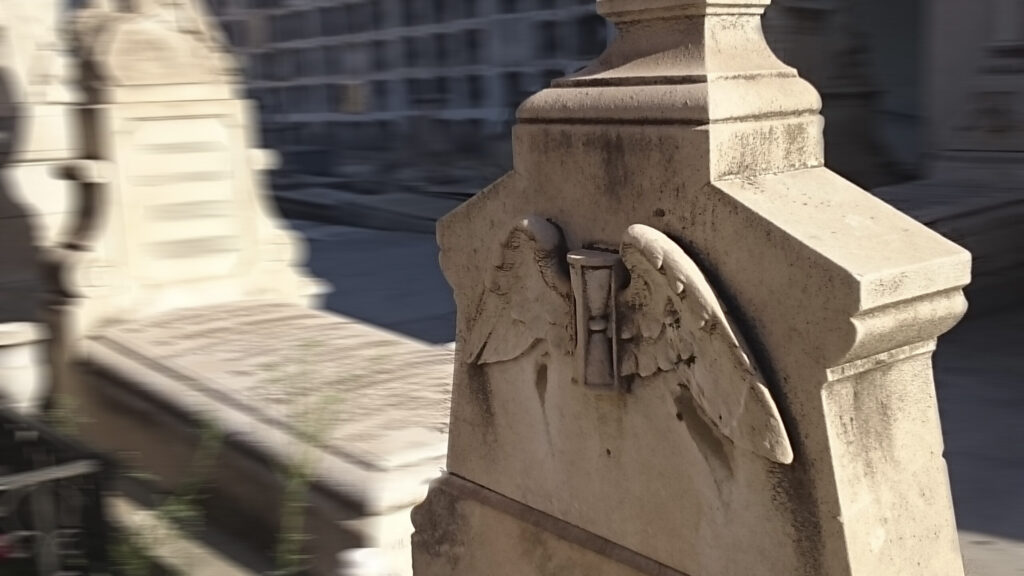
One of the most recognizable motifs is the winged skull, sometimes called the “death’s head.” The skull represented the physical reality of death, while the wings symbolized the soul leaving the body.
Other common symbols appeared regularly on early headstones:
- Hourglasses, representing the passage of time and the inevitability of life running out.
- Extinguished candles, symbolizing a life suddenly ended.
- Skeletons or the Grim Reaper, personifications of death gathering human lives.
- Bones and crossbones, emphasizing the unavoidable physical reality of mortality.
Many stones also included inscriptions directed toward the living. Some addressed the passerby directly, reminding them that they too would one day join those beneath the ground.
The message was not intended to be bleak. Instead, it served as a moral reminder: life was short, and therefore how one lived mattered.
By the late eighteenth century, the stark imagery of memento mori began to soften. Cultural attitudes toward death were changing, and cemetery art reflected this shift.
The skulls gradually disappeared. In their place came cherubs, angels, urns, clasped hands, and weeping willows, symbols that emphasized mourning, remembrance, and the hope of reunion beyond death.
This transformation mirrored broader social changes. As the nineteenth century progressed, death became increasingly sentimentalized. Cemeteries evolved into park-like landscapes meant for reflection and remembrance rather than moral instruction.
Yet the earlier symbols never disappeared entirely. They remain preserved in older burial grounds, offering insight into how previous generations understood life and mortality.
Today, visitors encountering these symbols often pause in curiosity. In an era where death is rarely discussed openly, the honesty of these carvings can feel striking.
But the purpose of memento mori was never simply to remind people that death exists. Its deeper message is about perspective.
To remember death is also to remember life and to recognize its brevity, its fragility, and its meaning.
Cemeteries, in this sense, are more than resting places for the dead. They are spaces where the past continues to speak quietly to the present.
Among the stones, carved centuries ago, is a simple but enduring reminder:
Life is finite. And therefore, it matters
*Article originally appeared in the Funeral Chronicle April 2026 written by Nicolas McCarthy.