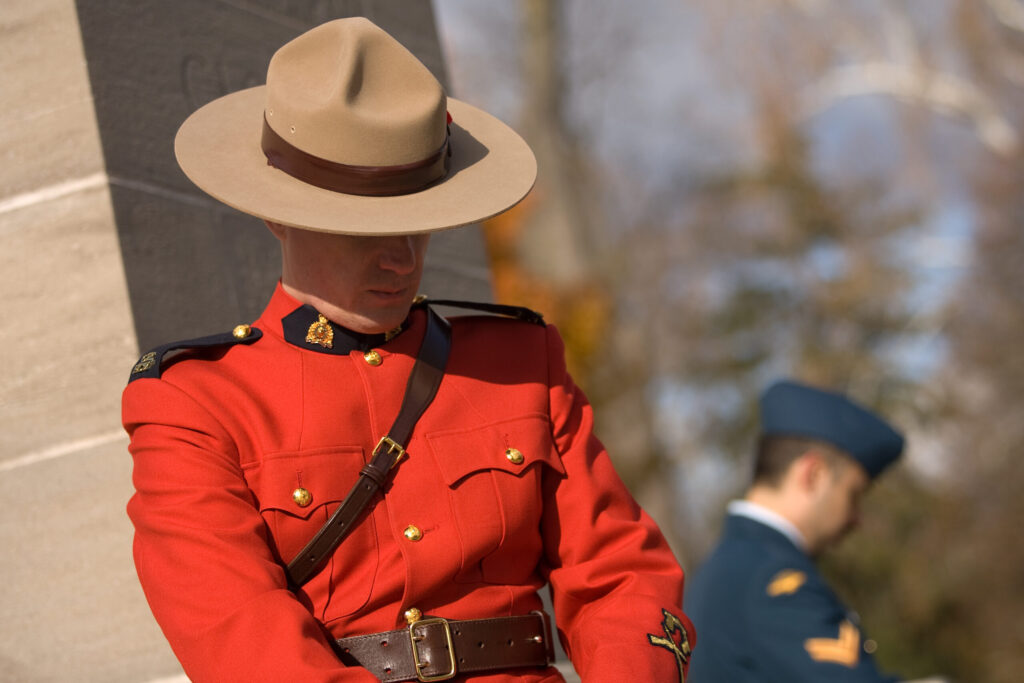
Few symbols are as instantly recognizable in Canada as the broad-brimmed brown Stetson worn by members of the Royal Canadian Mounted Police. Around the world, it has become synonymous with the RCMP, representing service, professionalism, tradition, and a uniquely Canadian identity.
Today, the Stetson is one of the defining elements of the RCMP’s ceremonial uniform. Yet its journey to becoming an official symbol of the Force was far from immediate.
On May 23, 2026, the RCMP National Memorial Cemetery at Beechwood unveiled a new commemorative plaque dedicated to the Stetson as part of the RCMP Uniforms and Traditions Commemorative Pathway Program. The plaque was one of six new installations unveiled during a special ceremony marking the 20th anniversary of the tri-partite partnership between the Royal Canadian Mounted Police, the Beechwood Cemetery Foundation, and the RCMP Veterans’ Association (Ottawa Division).
A Practical Beginning
When the North-West Mounted Police (NWMP) was established in 1873, its members were not issued the famous Stetson. Instead, officers and rank-and-file members wore military-style pith helmets and brimless forage caps. These items reflected British military traditions but quickly proved unsuitable for life on the Prairies.
The vast landscapes of Western Canada presented challenges that military dress regulations had not anticipated. Summers were hot, dusty, and exposed. The stiff helmets and caps offered little protection from the elements and were unpopular among members of the Force.
By the late 1870s, many Mounted Police members began adopting soft felt slouch hats inspired by those worn by American soldiers and frontiersmen. These hats offered greater comfort, flexibility, and protection from the sun. Their popularity spread rapidly across the Prairies, and photographs from the era show a remarkable variety of shapes and styles as members personalized their headwear.
The Hat of the West
The broad-brimmed felt hat quickly became more than a practical solution. It reflected the realities of life on the frontier and became closely associated with the Mounted Police presence across Western Canada.
Its wide brim shielded officers from the harsh Prairie sun, while its pliable felt construction made it durable and adaptable. The hat was perfectly suited to the demanding conditions encountered during patrols, settlements, and long journeys across the vast Canadian West.
Although not yet officially authorized, the hat had become deeply embedded in the culture of the Mounted Police.
A Symbol Before It Was Official
One of the most notable appearances of the future Stetson came in 1897 when members of the Mounted Police travelled to England to participate in Queen Victoria’s Diamond Jubilee celebrations.
Despite not being an officially approved article of dress, many members proudly wore the broad-brimmed hat during the festivities. The distinctive appearance of the Mounted Police attracted significant public attention and helped cement the image of the Force in the minds of both Canadians and international observers.
Three years later, in 1900, a Stetson-style hat known as the “Boss of the Plains” received approval for private purchase by members. While this was an important step, it still had not become standard issue.
Official Adoption
In June 1904, the Stetson pattern was formally approved as an official article of dress for the Mounted Police.
More than a century later, it remains one of the most enduring symbols of the RCMP. While subtle modifications have been made over the years, the essential design has remained remarkably consistent. Its distinctive shape continues to evoke the history, traditions, and service of generations of Mounted Police officers.
Viewed anywhere in the world, the Stetson immediately identifies the wearer as part of one of Canada’s most respected institutions.
Preserving the Legacy
The unveiling of the Stetson plaque at the RCMP National Memorial Cemetery at Beechwood serves as a reminder that symbols carry stories.
Alongside plaques dedicated to the Red Serge, the Riders’ Lances, the High Brown Boots and Jack Spurs, RCMP ranks, and the Force’s badge and motto, the Stetson plaque helps tell the story of the traditions that have shaped the RCMP for more than 150 years. During the unveiling ceremony, representatives of the National Police Federation participated in revealing the plaque, recognizing the enduring connection between today’s serving members and the generations who came before them.
For visitors to the RCMP National Memorial Cemetery at Beechwood, the plaque offers an opportunity to learn about a symbol that began as a practical piece of frontier headwear and evolved into one of Canada’s most iconic national emblems.
More than a hat, the Stetson represents duty, service, and a proud legacy that continues to inspire Canadians from coast to coast.
*The plaque was officially unveiled on May 23, 2026, during the RCMP Commemorative Pathway Ceremony at the RCMP National Memorial Cemetery at Beechwood.