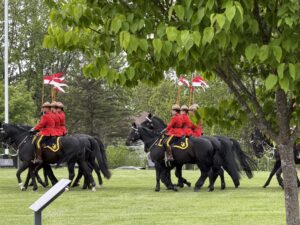
Among the many symbols associated with the Royal Canadian Mounted Police, few are as striking as the red-and-white pennoned lances carried by riders of the Musical Ride. While often viewed today as ceremonial objects, the lances have a rich history that stretches back centuries and connects the RCMP to military traditions from Europe, the British Army, and the earliest days of the North-West Mounted Police.
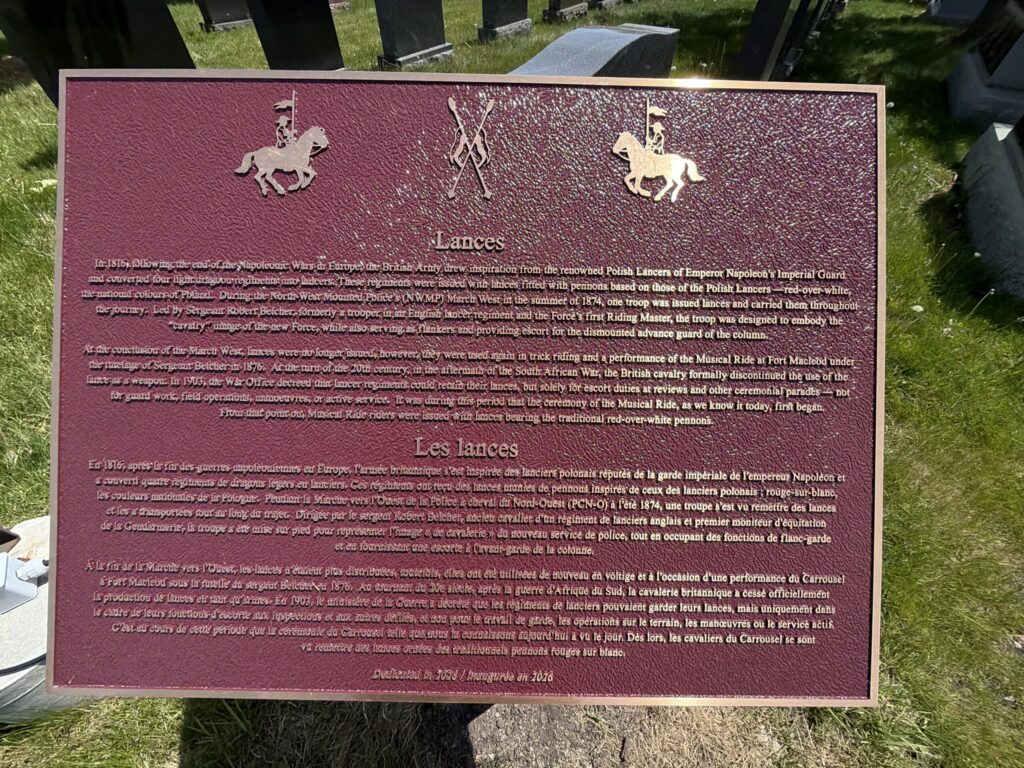
On May 23, 2026, the RCMP National Memorial Cemetery at Beechwood unveiled a new commemorative plaque dedicated to the Riders’ Lances as part of the RCMP Uniforms and Traditions Commemorative Pathway Program. The plaque was one of six new heritage installations unveiled during a special ceremony marking the 20th anniversary of the partnership between the Royal Canadian Mounted Police, the Beechwood Cemetery Foundation, and the RCMP Veterans’ Association (Ottawa Division).
A Tradition Born in Europe
The story of the lance begins long before the creation of the North-West Mounted Police.
In 1816, following the end of the Napoleonic Wars, the British Army sought to modernize elements of its cavalry. Inspired by the renowned Polish Lancers of Napoleon’s Imperial Guard, four British light dragoon regiments were converted into lancer regiments.
These regiments adopted distinctive lances adorned with red-over-white pennons, reflecting the national colours of Poland. The brightly coloured pennons served both practical and ceremonial purposes, making cavalry formations more visible while also creating a dramatic visual effect during military manoeuvres and parades.
The image of the lancer quickly became one of the most recognizable symbols of mounted military service throughout the British Empire.
The March West
When the North-West Mounted Police undertook the historic March West in the summer of 1874, lances accompanied them onto the Canadian frontier.
One troop was specifically equipped with lances and carried them throughout the journey. The troop was commanded by Sergeant Robert Belcher, a former member of an English lancer regiment who also served as the Force’s first Riding Master.
Belcher’s troop was intended to project the image of a disciplined cavalry force as the new police organization moved westward. In addition to their symbolic role, the mounted troop performed practical duties, acting as flankers and escorting the dismounted advance guard of the column.
For a young nation seeking to establish law and order across a vast territory, the sight of mounted policemen carrying lances conveyed authority, professionalism, and confidence.
From Frontier Tool to Ceremonial Symbol
Despite their prominence during the March West, the lances were not retained as standard equipment after the journey concluded.
Their connection to the Mounted Police might have ended there were it not for Sergeant Belcher’s continued influence. In 1876, he reintroduced the lances during trick-riding demonstrations and an early performance of what would eventually become the Musical Ride at Fort Macleod.
These performances combined horsemanship, discipline, and pageantry, creating a unique tradition that captured the public imagination.
Over time, the lance evolved from a practical cavalry tool into a ceremonial symbol that reflected the Mounted Police’s mounted heritage.
The Birth of the Modern Musical Ride
The turn of the twentieth century marked another important chapter in the story of the lance.
Following the South African War, military thinking within the British Army changed significantly. Advances in technology and warfare made traditional cavalry weapons increasingly obsolete.
In 1903, the British War Office formally discontinued the lance as an operational weapon. Lancer regiments were permitted to retain their lances only for ceremonial duties, including escorts, military reviews, and public parades.
It was during this same period that the Musical Ride began to take shape in the form that Canadians recognize today.
As the ceremony evolved, riders were once again issued lances carrying the traditional red-over-white pennons. No longer weapons of war, they became symbols of heritage, precision, and excellence in horsemanship.
A Symbol of Tradition and Excellence
Today, the red-and-white pennoned lance remains one of the defining features of the RCMP Musical Ride.
Whether performing in communities across Canada or representing the country on the international stage, Musical Ride riders continue to carry lances that connect them to more than two centuries of mounted tradition.
The sight of riders executing intricate cavalry movements while carrying these historic symbols continues to inspire audiences and celebrate the enduring legacy of the RCMP.
Preserving the Story
The Riders’ Lances plaque at the RCMP National Memorial Cemetery at Beechwood helps preserve an important chapter in the history of the Mounted Police.
It stands alongside plaques dedicated to the Red Serge, the Stetson, the High Brown Boots and Jack Spurs, RCMP ranks, and the Force’s badge and motto. Together, these installations tell the story of the traditions, symbols, and heritage that have shaped the RCMP for more than 150 years.
During the unveiling ceremony, the Officer in Charge of the RCMP Musical Ride participated in revealing the plaque, recognizing the enduring connection between today’s riders and the mounted traditions established during the Force’s earliest years.
For visitors to the RCMP National Memorial Cemetery at Beechwood, the Riders’ Lances plaque serves as a reminder that the most enduring symbols often carry stories that span generations.
What began as a cavalry weapon on European battlefields became a symbol of service on the Canadian frontier and ultimately an enduring emblem of one of Canada’s most cherished traditions.
The Riders’ Lances are more than ceremonial equipment. They represent heritage, horsemanship, and a proud legacy that continues to ride forward through each new generation of the Royal Canadian Mounted Police.
*The Riders’ Lances plaque was officially unveiled on May 23, 2026, during the RCMP Uniforms & Traditions Commemorative Pathway Ceremony at the RCMP National Memorial Cemetery at Beechwood.