Few symbols are as instantly recognizable in Canada as the badge of the Royal Canadian Mounted Police. At its centre stands the head of a prairie bison, surmounted by the Crown and encircled by the French motto Maintiens le droit – “Uphold the Right.” Together, these elements have represented duty, service, and the rule of law for more than 150 years.
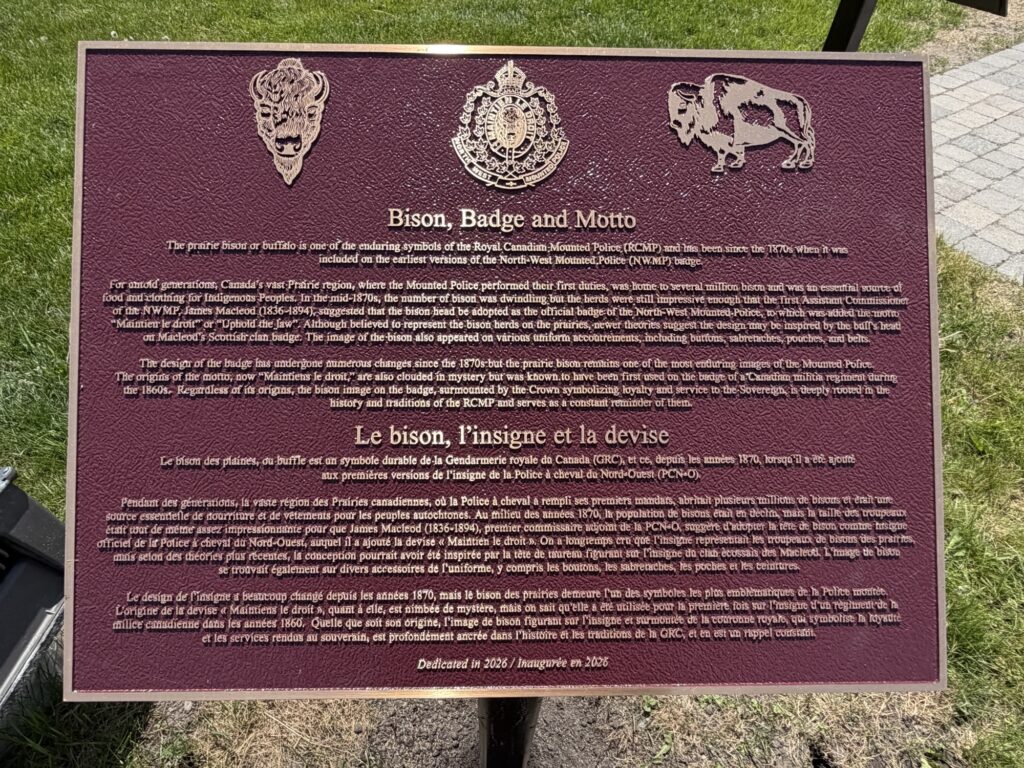
Yet behind this familiar emblem lies a remarkable history that stretches back to the earliest days of the North-West Mounted Police and the opening of Canada’s West. Today, visitors to the RCMP National Memorial Cemetery at Beechwood can discover this story through the Bison, Badge and Motto interpretive plaque, one of many installations that explore the traditions and heritage of Canada’s national police service.
A Symbol Born on the Prairies
When the North-West Mounted Police (NWMP) was established in 1873, Canada was undergoing one of the most significant periods of expansion in its history. The newly created force was tasked with bringing law and order to the vast North-West Territories, enforcing Canadian sovereignty, supporting treaty relationships, and protecting settlers and Indigenous communities alike.
The landscape into which the Mounted Police rode was dominated by one extraordinary animal, the prairie bison.
For thousands of years, millions of bison roamed the Great Plains of North America. To Indigenous Peoples, the bison was far more than wildlife. It provided food, clothing, shelter, tools, and spiritual meaning, sustaining entire cultures and economies across the Prairies.
By the mid-1870s, however, the great herds were rapidly disappearing. Commercial hunting and westward expansion had pushed the species toward collapse. Even so, the bison remained the defining image of the Canadian West and the land where the Mounted Police first carried out their duties.
James Macleod’s Vision
It was during these formative years that Assistant Commissioner James Macleod proposed that the bison become the official emblem of the North-West Mounted Police.
Born in Scotland in 1836, Macleod was one of the founding officers of the force and one of its most respected leaders. He believed the badge should reflect the unique environment in which the Mounted Police served, and no symbol better represented the Prairies than the bison.
The original badge combined the head of a prairie bison with the French motto Maintiens le droit “Uphold the Right.” The design quickly became synonymous with the young police force and appeared on uniforms, buttons, belts, pouches, sabretaches, and other ceremonial equipment.
Interestingly, historians continue to debate the true inspiration for the design. While generations have believed the bison simply represented the great herds of the Prairies, more recent scholarship suggests Macleod may also have drawn inspiration from the bull’s head that appeared on the badge of his own Scottish clan. Whether influenced by the Canadian landscape, his family heritage, or both, the result became one of the most enduring symbols in Canadian policing.
“Maintiens le droit”
Just as intriguing as the bison itself is the motto that accompanies it.
Maintiens le droit has long been translated as “Uphold the Right” or “Maintain the Right.” While its precise origins remain uncertain, historians know the phrase appeared on the badge of a Canadian militia regiment during the 1860s, predating the creation of the Mounted Police. It was later adopted by the NWMP and has remained part of the organization’s identity ever since.
Unlike many mottos that focus on victory or conquest, Maintiens le droit expresses a continuing responsibility. It reflects the ongoing obligation to uphold justice, fairness, and the rule of law, principles that have defined the Mounted Police throughout their history.
The Crown and Service
Completing the badge is the Crown, symbolizing loyalty and service to the Sovereign.
As Canada evolved from colony to Dominion and ultimately to an independent constitutional monarchy, the Crown remained a visible reminder that members of the Mounted Police and later the Royal Canadian Mounted Police, serve not political interests but the Canadian state and its people.
Together, the Crown, the bison, and the motto create a badge that tells a uniquely Canadian story, linking geography, history, tradition, and public service into a single enduring emblem.
From the North-West Mounted Police to the RCMP
Although the organization itself changed names, from the North-West Mounted Police to the Royal North-West Mounted Police in 1904, and finally to the Royal Canadian Mounted Police in 1920, the bison never disappeared.
The badge has been redesigned many times over the past century and a half, incorporating new artistic styles and heraldic details. Yet through every revision, the prairie bison has remained at its heart.
Few organizational symbols in Canada have demonstrated such continuity. Generations of Mounties have worn the same central emblem, connecting today’s officers with those who first patrolled the Prairies nearly 150 years ago.
A Symbol Remembered at Beechwood
At the RCMP National Memorial Cemetery at Beechwood, Canada’s National Cemetery, history is preserved not only through those laid to rest, but also through the stories that define the institution they served.
The Bison, Badge and Motto interpretive plaque invites visitors to look beyond the familiar insignia and discover the deeper meaning behind one of Canada’s most recognizable symbols. It reminds us that every detail of the RCMP badge carries history: the vast Prairie landscape, the legacy of the North-West Mounted Police, the traditions of service under the Crown, and an enduring commitment to justice embodied in the words Maintiens le droit.
As one of several interpretive installations along the pathway, it helps preserve and share the rich heritage of the Royal Canadian Mounted Police, ensuring that visitors gain a deeper understanding of the symbols, traditions, and history that have shaped Canada’s national police service for more than 150 years.
More than a decorative emblem, the RCMP badge represents nearly a century and a half of service to Canada. At its centre, the prairie bison continues to stand as a powerful reminder of the force’s origins, its enduring traditions, and the generations of Canadians who have worn the badge with honour.
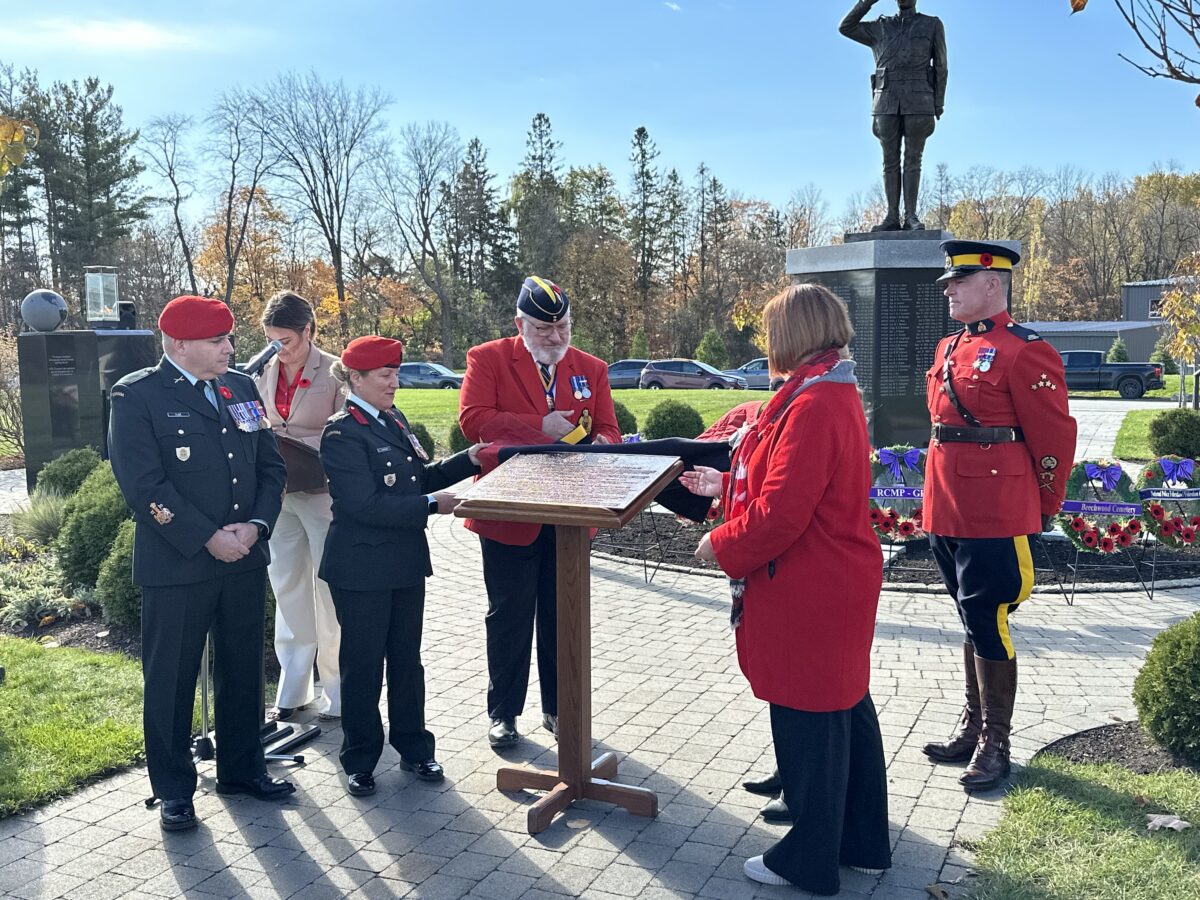
*The plaque was officially unveiled on May 23, 2026, during the RCMP Uniforms & Traditions Commemorative Pathway Ceremony at the RCMP National Memorial Cemetery at Beechwood Cemetery.