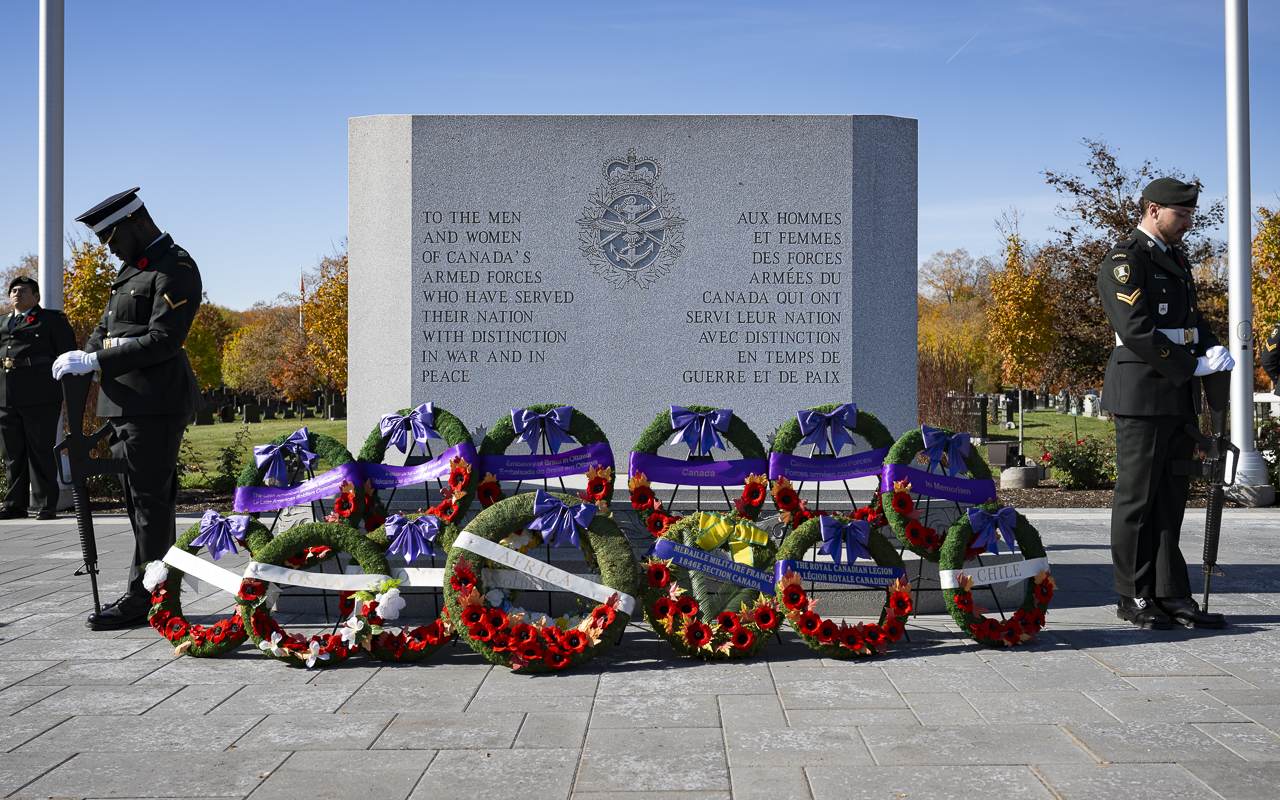
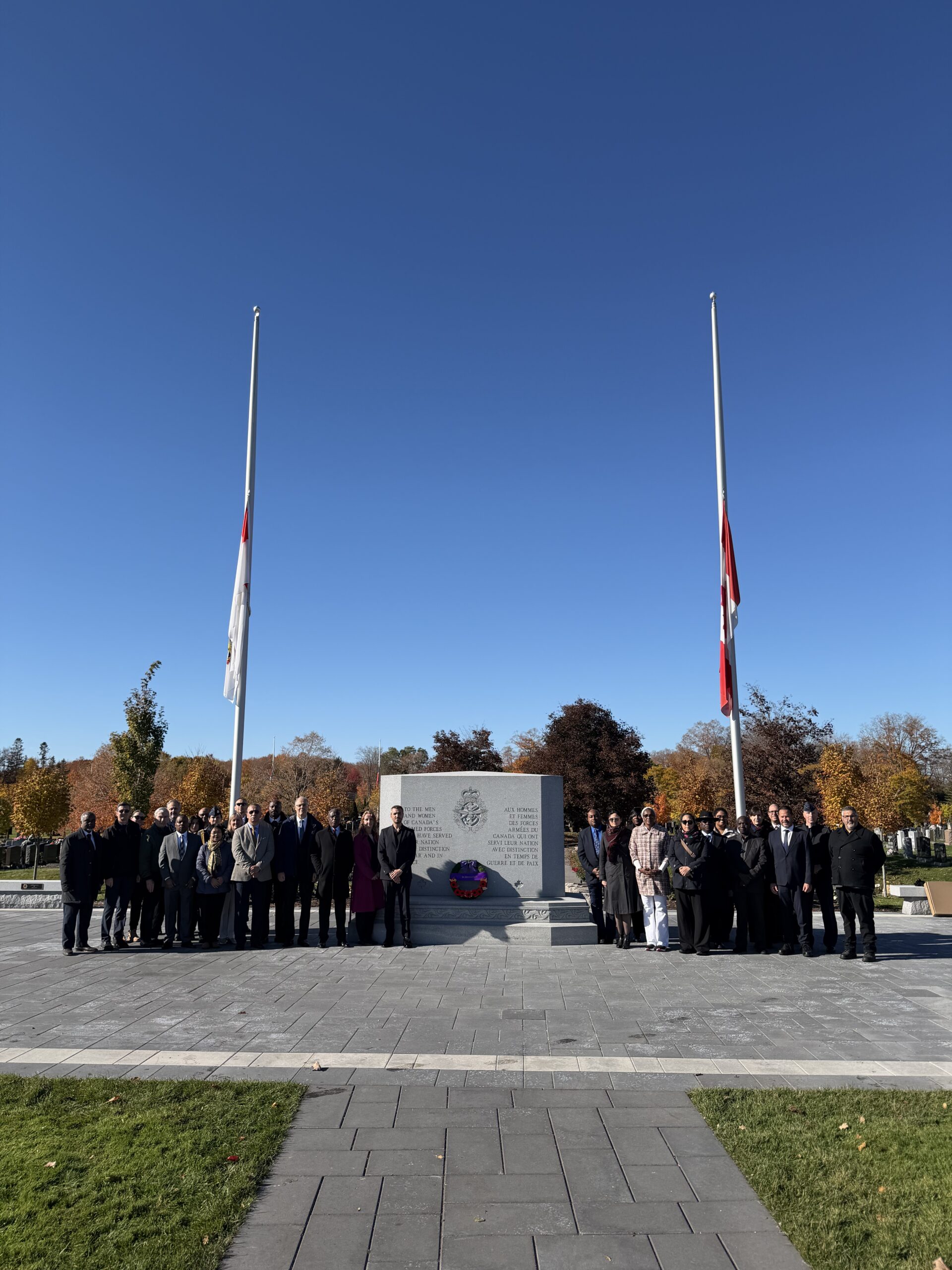
On November 8, 2020, a commemorative plaque was unveiled along the Major-General George R. Pearkes, VC, Pathway in the RCMP National Memorial Cemetery at Beechwood.
The plaque honours the members of No. 1 Provost Company (RCMP), who carried the traditions and insignia of the Royal Canadian Mounted Police into the battlefields of the Second World War. It is dedicated to the 215 RCMP members recorded as having volunteered for service with the company and commemorates 12 members who died while serving during the war.
Answering the Call
When Canada declared war on Nazi Germany on September 10, 1939, the Canadian Army did not have a permanent, centralized military police corps.
RCMP Commissioner Stuart Taylor Wood had anticipated the need. Before Canada formally entered the war, he approached the Department of National Defence with an offer to form a provost company from RCMP volunteers. The proposal allowed the RCMP to contribute a specialized unit to the overseas war effort while continuing its essential policing and security responsibilities in Canada.
The response from RCMP members was immediate. By mid-September, approximately 115 members had been selected and were training at the RCMP’s “N” Division in Rockcliffe, Ottawa. Their preparation included military drill, first aid, traffic control and motorcycle training.
In December 1939, No. 1 Provost Company departed Ottawa for Halifax before sailing for Britain with the 1st Canadian Infantry Division. After arriving at Greenock, Scotland, the company proceeded to Aldershot, England, where much of the Canadian Army was stationed.
The members served in Canadian Army uniforms while continuing to wear RCMP badges and insignia—a visible reminder of the unit’s origins and its distinctive place within Canada’s military history. RCMP historical records describe the company as the unit that carried the traditions and insignia of the Force into the war in Europe.
The Foundation of the Canadian Provost Corps
On June 15, 1940, the Canadian Provost Corps was formally established. No. 1 Provost Company provided its operational foundation and supplied experienced personnel for newly created provost units.
As the Canadian Army expanded, members originally selected for No. 1 Company were commissioned, promoted or reassigned to help establish and lead other military police formations. By the end of the war, the Canadian Provost Corps had grown into a substantial organization supporting Canadian operations at home and overseas.
Provost personnel performed a wide range of responsibilities. They enforced military discipline, investigated incidents, guarded and processed prisoners of war, protected critical locations, controlled access to operational areas and helped maintain order in communities affected by combat.
Their most important battlefield responsibility was often traffic control.
Modern armies depended on the continuous movement of troops, ammunition, fuel, food, medical supplies and equipment. A blocked road or misdirected convoy could delay an entire operation. Provost personnel marked routes, directed vehicles, managed intersections, responded to accidents and kept military traffic moving, often while exposed to artillery fire, air attacks and mines.
The Dieppe Connection
The Dieppe Raid took place on August 19, 1942. The 41-person provost contingent assigned to the operation came from No. 2 Provost Company, not No. 1.
However, its leadership had direct connections to the original RCMP company. Captain Edward Hammond Stevenson, who commanded the Dieppe provost contingent, had joined No. 1 Provost Company as an RCMP volunteer. His second-in-command, Lieutenant Peter Seddon Oliver, had also begun his wartime service with No. 1 before receiving his commission and transferring to No. 2 Company.
The provost personnel were expected to land with the tanks, direct troops and equipment away from the beach, establish cordons and organize the eventual withdrawal. As the raid collapsed, they fought alongside the infantry and engineers.
Of the 41 provost personnel who participated, 22 returned to England, 18 became prisoners of war and one, Peter Seddon Oliver, was killed. The Canadian Military Police Association’s history of Dieppe documents their role and the direct connection between the two companies.
Sicily and Italy
No. 1 Provost Company landed in Sicily with the 1st Canadian Infantry Division on July 10, 1943. During the six-week Sicilian campaign, its members supported the movement of the division across hundreds of kilometres while managing prisoners, marking routes and maintaining traffic under dangerous conditions.
The company crossed into mainland Italy in September 1943 and continued supporting Canadian operations as Allied forces advanced northward. Its members served through some of the most difficult fighting of the Italian Campaign, including operations around Campobasso, the Moro River, Ortona, the Gustav Line, the Liri Valley, the Hitler Line and the Rimini Line.
In the Cassino area, Canadian provost personnel assisted the British Corps of Military Police in controlling traffic along Highway 6. Approximately 11,000 vehicles used the route each day. Keeping this narrow and heavily travelled supply line operating was essential to sustaining the Allied advance.
The work came at a significant cost.
During the fighting around Ortona in December 1943, Edison Alexander Cameron, David Charles Gardner Moon, Terence Graham Newcomen Watts and Gordon Evan Bondurant were killed or mortally wounded. Cameron, Moon and Watts died on December 28, 1943. Bondurant later died from his wounds on January 8, 1944.
Three more RCMP members serving with the Provost Corps were killed in Italy during May 1944. Kenneth Laurence d’Albenas was killed when his jeep struck a mine on May 15. John Francis Joseph Nelson was killed by shellfire on May 22. Donald Gilbert Stackhouse was killed when his motorcycle struck a mine on May 31.
Their service is recorded on the RCMP Honour Roll maintained by Veterans Affairs Canada.
From Italy to the Netherlands
In early 1945, the 1st Canadian Corps was transferred from Italy to northwestern Europe. No. 1 Provost Company joined the campaign to liberate the Netherlands and served during operations around Apeldoorn.

The company continued carrying out traffic control, security and policing duties as Canadian forces advanced through the Netherlands and into Germany.
No. 1 Provost Company was deactivated on October 18, 1945, following its repatriation to Canada. Its wartime service had helped establish a lasting relationship between the RCMP and Canada’s military police community.
The Plaque at Beechwood
The plaque unveiled at Beechwood on November 8, 2020, was installed during the year marking the 75th anniversary of the end of the Second World War. It stands as a permanent tribute to the RCMP members who volunteered for overseas service and to those who did not return.
The plaque reads:
1 PROVOST COMPANY (RCMP)
PREMIÈRE COMPAGNIE DE LA PRÉVÔTÉ (GRC)
CANADIAN ACTIVE SERVICE FORCE / ARMÉE ACTIVE DU CANADA
1ST CANADIAN INFANTRY DIVISION / LA PREMIÈRE DIVISION D’INFANTERIE DU CANADA
DEDICATED TO THE 215 VOLUNTEER MEMBERS OF THE ROYAL CANADIAN MOUNTED POLICE WHO, DURING WORLD WAR II SERVED OVERSEAS IN THE NO. 1 PROVOST COMPANY (RCMP) (1939-1945) AND IN MEMORY TO THOSE WHO WERE KILLED WHILE SERVING.
DÉDIÉE AUX 215 MEMBRES DE LA GENDARMERIE ROYALE DU CANADA QUI SE SONT PORTÉS VOLONTAIRES PENDANT LA SECONDE GUERRE MONDIALE AFIN DE SERVIR OUTRE-MER DANS LA PREMIÈRE COMPAGNIE DE LA PRÉVÔTÉ DE LA GRC (1939-1945) ET À LA MÉMOIRE DE CEUX QUI FURENT TUÉS AU COURS DE LEUR SERVICE.
No. de mat. / Reg. No. 10063
Cst. / gend. Charles James Johnstone
1941 — At sea / en mer
No. de mat. / Reg. No. 11003
Cst. / gend. Charles Floyd Patterson
1941 — England / Angleterre
No. de mat. / Reg. No. 11288
L/Cpl. / cap.s. Andrew Drummond-Hay
1942 — Egypt / Égypte
No. de mat. / Reg. No. 12572
Cst. / gend. Peter Seddon Oliver
1942 — France
No. de mat. / Reg. No. 13205
Cst. / gend. James Harvard Delamere Bedlington
1943 — England / Angleterre
No. de mat. / Reg. No. 12856
Cst. / gend. Edison Alexander Cameron
1943 — Italy / Italie
No. de mat. / Reg. No. 13157
Cst. / gend. David Charles Gardner Moon
1943 — Italy / Italie
No. de mat. / Reg. No. 13064
Cst. / gend. Terrance Graham Newcomen Watt
1943 — Italy / Italie
No. de mat. / Reg. No. 12985
Cst. / gend. Gordon Evan Bondurant
1944 — Italy / Italie
No. de mat. / Reg. No. 13678
Cst. / gend. Kenneth Laurence d’Albenas
1944 — Italy / Italie
No. de mat. / Reg. No. 12398
Cst. / gend. John Francis Joseph Nelson
1944 — Italy / Italie
No. de mat. / Reg. No. 12108
Cst. / gend. Donald Gilbert Stackhouse
1944 — Italy / Italie
A Legacy of Service
The story of No. 1 Provost Company is one of professional service carried from civilian policing into military operations.
Its members did not simply enforce regulations. They protected soldiers, maintained critical supply routes, brought order to dangerous environments and helped keep the Canadian Army moving through some of the most difficult campaigns of the Second World War.
At the RCMP National Memorial Cemetery, their plaque ensures that this important connection between the RCMP and Canada’s military police history remains visible.
It also preserves the names of those who volunteered, served and sacrificed.
Lest we forget.