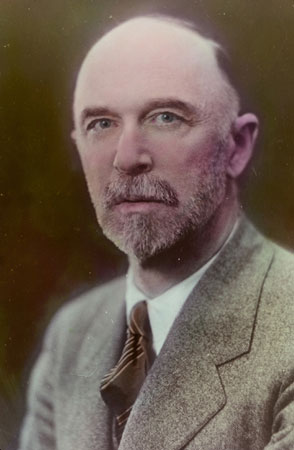
Harlan Ingersoll Smith
Section 30, Lot TG 122
Born in East Saginaw, Michigan on February 17, 1872. He attended the University of Michigan before pursuing a career in archaeology. Primarily self-trained, Smith gained significant practical experience working at the American Museum of Natural History. While there, he participated as archaeologist in the Jessup North Pacific Expedition from 1897 to 1899.

In 1891, he obtained a position on the staff of the Peabody Museum in Massachusetts. The first opportunity to do actual field work came in 1891, when the late Professor Putnam, Chief of the Anthropological Department of the World’s Columbian Exposition in Chicago, employed him to assist Dr. Charles Metz in the exploration of the well-known Madisonville Village Site in Ohio. This was followed in 1892 by field trips to other sites in Ohio; in 1893 to mounds near Madison Wisconsin, and in 1894, as explorer for the Archaeological Institute of America, to Kalamazoo, Michigan, to investigate the so-called “gardenbeds” near that place. From 1895 to 1911, he was on the staff of the American Museum of Natural History in New York.
In 1911, Harlan I. Smith joined the Geological Survey of Canada as head of its archeology division. This unit, along with the ethnography division later evolved into what is now the Canadian Museum of Civilization. Smith’s early years as an archaeologist with the GSC were spent excavating and investigating potential archaeological sites in eastern Canada, Ontario and British Columbia.
In 1920, he began what would become several years of ethnographic work in the Bella Coola Valley of British Columbia. Although he conducted archaeological investigations, his main focus was the documentation of the traditional uses of plants and animals, social organization and cultural traditions of the Nuxalk, Dakelh-ne and Chilcotin people.

Besides archaeological mapping and the creation of an impressive inventory of archaeological sites in Canada, Harlan I. Smith was a pioneer in ethnographic film-making, anthropological photography and museum education. Smith was unique for his time, in that he tried to ensure that the people he photographed received copies of their portraits. He wrote extensive captions for his photographs that included detailed information on the subject, date, location, and often, camera angle. These images and associated information continue to be of use and importance to researchers.
He was the author of An Album of Prehistoric Canadian Art (1923) and wrote numerous reports and contributions to scientific periodicals.
Smith died on January 28, 1940 in Ottawa.