
Portuguese Community
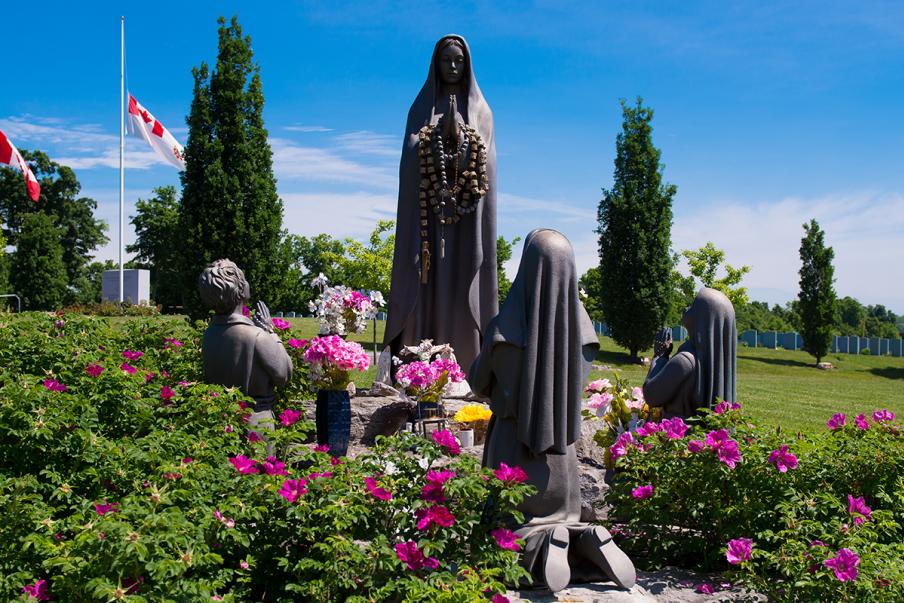
In 1997, Beechwood Cemetery Foundation and Ottawa’s Portuguese community established a dedicated section within Beechwood Cemetery for the exclusive use of Portuguese families and parish members. Located in Section 101, this sacred space contains more than 200 lots of varying sizes and was created to serve generations of the community, providing a permanent place of remembrance, faith, and cultural continuity within the National Cemetery of Canada.
The Portuguese section reflects the strong connection between faith, family, heritage, and remembrance that has long defined the Portuguese Canadian community in Ottawa. For many families, the section represents not only a burial space, but also a place where traditions, language, spirituality, and collective memory continue to live on through future generations.
At the heart of the section stands a statue of Our Lady of Fatima, one of the most important religious symbols in Portuguese culture and Catholic devotion worldwide. The monument serves as both a spiritual focal point and a powerful symbol of hope, peace, compassion, and protection.
The story of Our Lady of Fatima dates back to 1917 in the small rural village of Fátima, Portugal. Between May and October of that year, the Virgin Mary is believed to have appeared six times to three young shepherd children: Lúcia dos Santos and her cousins Francisco and Jacinta Marto. During these apparitions, the children reported receiving messages calling for prayer, repentance, devotion to the Holy Trinity, and daily recitation of the Rosary to bring peace to the world and an end to war during the devastation of the First World War.
The events at Fátima would become one of the most significant Marian apparitions in modern Catholic history. The messages of Fátima emphasized peace, sacrifice, compassion, and spiritual reflection, themes that continue to resonate deeply within Portuguese communities around the world.
The three shepherd children also hold an important place within the Catholic Church today. Francisco and Jacinta Marto, who died shortly after the apparitions during the influenza pandemic, were canonized as saints by Pope Francis on May 13, 2017, exactly 100 years after the first apparition at Fátima. They became the youngest non-martyr saints in the history of the Catholic Church. Lúcia dos Santos later became a Carmelite nun and dedicated her life to religious service and sharing the message of Fátima. Her cause for canonization remains ongoing, and she is currently recognized by the Church with the title “Servant of God,” an important step in the path toward sainthood.
The global importance of Our Lady of Fatima was further reinforced on May 13, 1981, when Pope John Paul II survived an assassination attempt in St. Peter’s Square. The Pope later credited his survival to the intervention and protection of Our Lady of Fatima, famously stating:
“It was a mother’s hand that guided the bullet’s path.”
One year later, Pope John Paul II travelled in pilgrimage to Fátima in thanksgiving, and the bullet removed after the assassination attempt was later placed within the crown of the statue of Our Lady of Fatima at the Sanctuary in Portugal.
Today, the Portuguese section and the statue of Our Lady of Fatima at Beechwood Cemetery stand as enduring symbols of faith, remembrance, resilience, and cultural identity. Together, they honour both the spiritual traditions of Portugal and the generations of Portuguese Canadians who helped shape Ottawa and Canada.