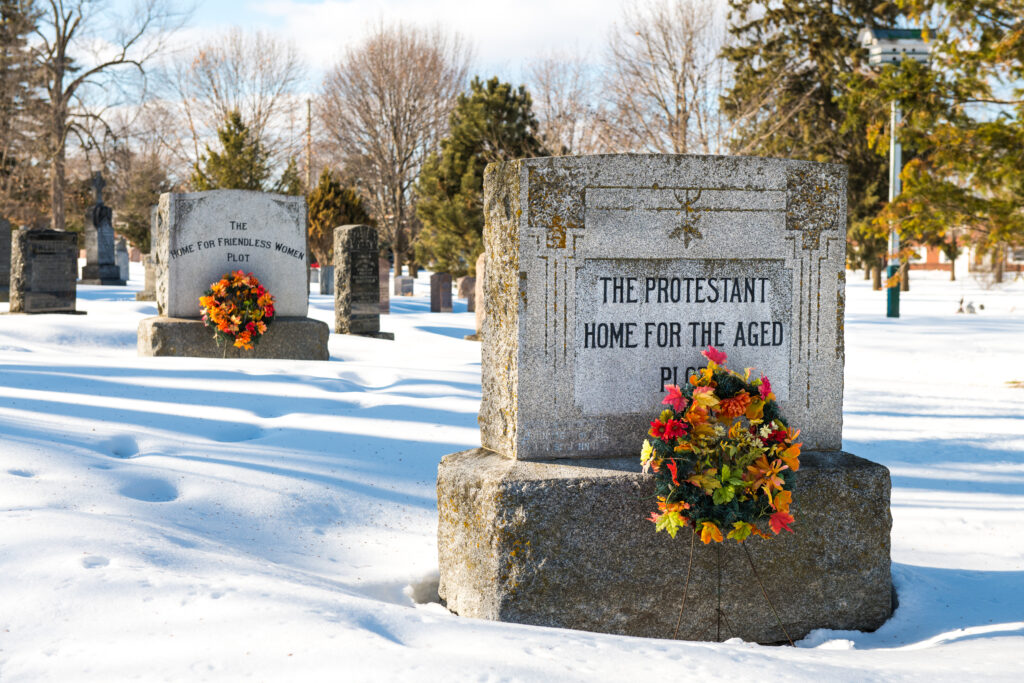
A short distance from Beechwood’s St. Laurent Boulevard entrance, three monuments stand together in Section 17. They mark the burial plots of the Protestant Orphans’ Home, the Protestant Home for the Aged and the Home for Friendless Women.
These monuments preserve an important chapter in Ottawa’s social history. They also recognize more than 80 men, women and children who died while receiving care from these charitable institutions.
Responding to a Growing City
During the second half of the 19th century, Ottawa experienced rapid growth. Government assistance programs were limited, leaving churches, charities and community organizations to support people experiencing poverty, homelessness, illness or family loss.
The three institutions represented in Section 17 were established by prominent Ottawa residents who wanted to improve these difficult conditions. The Protestant Orphans’ Home opened in 1865, the Home for Friendless Women in 1887 and the Protestant Home for the Aged in 1889.
Although the language used by these organizations reflected the social attitudes of their time, their work helped establish a foundation for Ottawa’s modern social-service system.
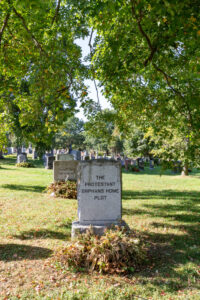
The Protestant Orphans’ Home
The Protestant Orphans’ Home was created by the Ladies’ Protestant Benevolent Association of Ottawa. Its mandate was to care for orphans and other children in need, support widows and provide temporary shelter for women who were unemployed.
The Home received its first child in 1865 from a rented brick house on Bank Street. Within a few years, it was caring for approximately 25 children.
As demand increased, the organization moved to larger facilities. In 1874, it purchased an entire block on Elgin Street between Lisgar and Cooper streets. Architect James Mather designed a new building for the site, which opened after a decade of fundraising.
By 1900, the Home was caring for 53 children and 19 elderly women. Provincial regulations eventually required children and elderly residents to be housed separately. A new children’s facility later opened on Carling Avenue in 1931 under the name Protestant Children’s Village. It also worked with the Children’s Aid Society to provide temporary care for children.
 The Home for Friendless Women
 The Home for Friendless Women
The Home for Friendless Women opened in 1887 to provide temporary shelter and employment to women who had nowhere else to go.
During its first year, the Home assisted women leaving prison, domestic servants who were unemployed, women living in poverty and mothers with children. Admission was offered without distinction based on nationality, age or religious background, although residents were expected to follow the Home’s rules and moral standards.
For many years, the organization operated from a large three-storey building at 327 Cambridge Street. The building remains standing today and has been converted into apartments.
A commercial laundry next door helped finance the Home. It also gave women an opportunity to earn wages and develop practical employment skills. By 1917, the laundry was generating more than $15,500 in annual revenue—a significant amount for the period.
The Home disappeared from Ottawa’s city directory after 1930, although its laundry continued operating for several more years.
The Protestant Home for the Aged
The Protestant Home for the Aged opened in 1889 as a place of refuge for elderly men.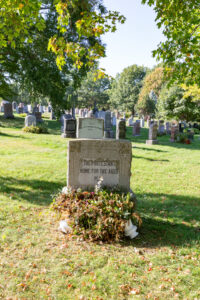
One year later, it moved into a stone farmhouse on Bank Street known as Abbotsford House. The building had previously belonged to Alexander Mutchmor and later Charles Mackintosh. As the number of residents increased, several additions were constructed, including an expansion designed by James Mather in 1895.
By 1913, the Home was caring for 34 men, including one resident who had reached the age of 104.
The Bronson Home for Protestant Aged Women provided similar care for elderly women. It began in the former Bronson family residence on Bronson Avenue. A purpose-built facility was later constructed at the corner of Bronson and Albert streets.
Over time, Abbotsford House became part of the Glebe Centre. These changes reflected a broader shift as governments and professional social-service organizations gradually assumed greater responsibility for caring for vulnerable residents.
Remembering Those Who Died
The three organizations operated for decades before acquiring their burial plots at Beechwood. The Protestant Orphans’ Home obtained its plot in 1918, the Protestant Home for the Aged in 1923 and the Home for Friendless Women in 1925.
Before these plots were established, cemetery records indicate that residents who died were buried in areas historically described as the “free ground,” “poor ground” or “pauper’s ground.” Many of these individuals had few resources and no family able to provide a private burial or permanent monument.
In 2013, an anonymous donor funded the creation and installation of a commemorative plaque near the three plots. It records the names of more than 80 people buried by the institutions.
The monuments themselves were restored through an earlier act of generosity. In 2010, members of the Canadian Federation of University Women’s diplomatic hospitality group donated funds to have their inscriptions re-lettered.
Preserving Every Story
These monuments are more than records of three former charitable institutions. They represent children who lost their families, women searching for safety and employment, and elderly residents who required care and companionship.
They also remind us that a city’s history is not told only through its most prominent citizens. It is also found in the lives of people who faced hardship and in the organizations that attempted to support them.
Thanks to the preservation of these plots and the names recorded on the commemorative plaque, those buried here are no longer forgotten.
Visitors can find the three monuments and commemorative plaque along the road in Section 17 of Beechwood Cemetery.
This article is based on Thomas Ritchie’s historical publication, No Longer Forgotten or Friendless. Ritchie was a longtime Friend of Beechwood and author of the “Set in Stone” column in The Beechwood Way. He died in 2014 and is buried at Beechwood Cemetery.