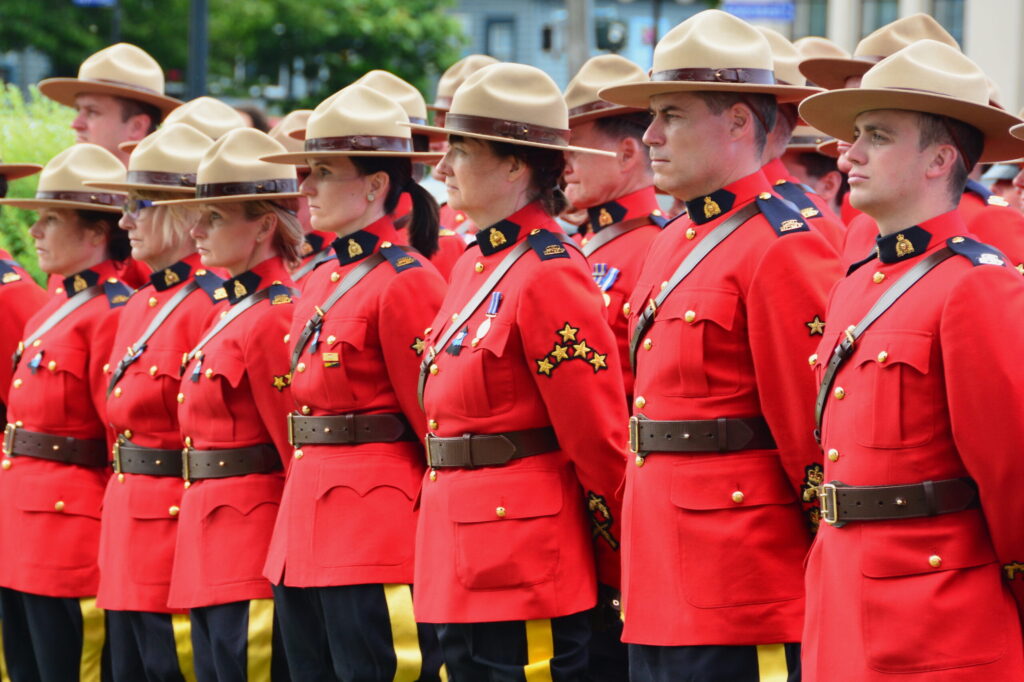
Few images are as instantly recognizable around the world as a member of the Royal Canadian Mounted Police standing proudly in Red Serge. The scarlet tunic, paired with the Stetson, riding breeches, high brown boots, and spurs, has become one of Canada’s most enduring national symbols.
More than a uniform, the Red Serge represents service, tradition, authority, and the evolution of Canada itself. For over 150 years, it has connected generations of Mounties to the origins of the North-West Mounted Police and remains a powerful reminder of the role the Force has played in shaping the nation.
Today, visitors to the RCMP National Memorial Cemetery at Beechwood can explore the history of this iconic uniform through a commemorative plaque unveiled as part of the RCMP Uniforms and Traditions Commemorative Pathway.
The Birth of a National Symbol
The story of the Red Serge begins in 1873 with the creation of the North-West Mounted Police (NWMP).
The newly established force was tasked with bringing law, order, and Canadian authority to the vast territories of Western Canada. Following Confederation, the young Dominion faced the challenge of governing an immense region stretching across the Prairies. The government sought a force that could establish a visible presence while maintaining peaceful relations with Indigenous peoples, settlers, and traders.
When selecting a uniform, officials deliberately looked to British military traditions. The scarlet tunic reflected the appearance of British Army regiments and was intended to project professionalism, discipline, and authority.
The choice of colour was also strategic.
At a time when many Canadians were familiar with the blue uniforms worn by the United States Cavalry, the distinctive red uniform immediately identified the Mounted Police as representatives of Canadian sovereignty. The colour red was associated with courage, strength, and stability, helping establish a unique identity for the new force.
The March West and the Building of a Nation
The Red Serge first gained prominence during the historic March West of 1874.
More than 300 members of the North-West Mounted Police set out from Manitoba and travelled across the Prairies to establish outposts in what is now Alberta and Saskatchewan. Facing extreme weather, limited supplies, and difficult terrain, the Mounted Police carried Canada’s presence into a rapidly changing frontier.
Photographs and illustrations from this period helped cement the image of the red-coated Mountie in the public imagination.
As settlements grew and Canada expanded westward, the Mounted Police became one of the most visible representations of federal authority. The Red Serge became synonymous with integrity, reliability, and service in communities across the country.
From Working Uniform to Ceremonial Dress
For decades, the Red Serge was not reserved for special occasions.
Members of the North-West Mounted Police and later the Royal Canadian Mounted Police wore the scarlet tunic during regular duties throughout much of the Force’s early history. Patrols, inspections, public ceremonies, and official functions were all conducted while wearing variations of the red uniform.
As policing evolved in the twentieth century, practicality gradually led to the adoption of more modern operational attire. By the early 1930s, the Red Serge was no longer commonly worn for everyday duties.
Its role, however, did not diminish.
Instead, it evolved into the ceremonial uniform that Canadians know today.
More Than a Uniform
The modern Review Order uniform consists of several iconic elements that together create one of the most recognizable ceremonial uniforms in the world.
The scarlet tunic is paired with the Stetson, introduced in 1904; a dark blue collar; blue riding breeches featuring a yellow stripe; and the famous high brown boots and spurs. Each component reflects a chapter in the history of the Mounted Police and contributes to a visual identity that has remained remarkably consistent for generations.
Together, these elements symbolize discipline, professionalism, and pride in service.
For serving members, the uniform represents a connection to those who came before them. For Canadians, it serves as a visible reminder of the country’s history and the institutions that helped shape it.
The Red Serge in Canadian Culture
Few uniforms have achieved the cultural significance of the Red Serge.
Over the past century, the image of the Mountie has appeared on postage stamps, postcards, tourism campaigns, advertising materials, commemorative items, and official government publications. It has been featured in films, television programs, cartoons, books, and international exhibitions.
For many people around the world, the Red Serge is one of the first images associated with Canada.
The uniform has also become a central feature of major national events. Whether welcoming heads of state, participating in royal visits, supporting commemorative ceremonies, or representing Canada abroad, the Red Serge continues to embody Canadian identity on the world stage.
A Symbol That Endures
Today, the Red Serge remains a source of national pride.
Although it is now worn primarily during ceremonial occasions, graduations, state events, and public celebrations, its meaning extends far beyond appearance. It represents more than a century and a half of service, dedication, and commitment to communities across Canada.
As the RCMP continues to evolve, the Red Serge remains a constant link between past and present, connecting modern members with the traditions and values established by the North-West Mounted Police in 1873.
Preserving RCMP Heritage at Beechwood
The RCMP National Memorial Cemetery at Beechwood is dedicated not only to remembering members and their families, but also to preserving the traditions and heritage of Canada’s national police service.
The Red Serge plaque forms part of the RCMP Uniforms and Traditions Commemorative Pathway, an initiative that highlights the symbols, customs, and stories that have shaped the RCMP throughout its history.
Together, these commemorative installations help ensure that future generations understand the significance of the traditions that continue to define the Force.
When visitors encounter the Red Serge along the pathway, they see more than a uniform.
They see a symbol of Canada itself, a symbol that has stood for service, authority, courage, and national identity for more than 150 years.

*The Red Serge plaque was officially unveiled on May 23, 2026, during the RCMP Uniforms & Traditions Commemorative Pathway Ceremony at the RCMP National Memorial Cemetery at Beechwood.