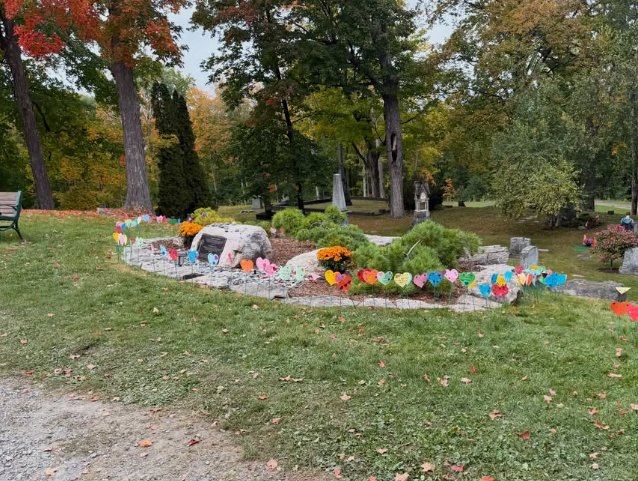
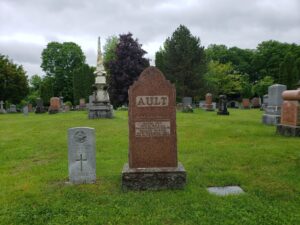
Section 29, Lot 43 E (S)
Long before women’s hockey had professional leagues, national television audiences or the institutional support it enjoys today, women were already building the game on outdoor rinks and in arenas across Canada.
In Ottawa, one of the most important players of that early era was Eva Catherine Ault, later Eva Catherine Buels. Known to hockey followers as the “Queen of the Ice,” Ault became a prominent member of the Ottawa Alerts during a formative period in the history of women’s hockey.
Her story is not simply one of an accomplished athlete. It belongs to a much larger history of women who played competitive hockey at a time when opportunities for female athletes were limited and the structures that would eventually govern the women’s game were only beginning to emerge.
Today, Eva Catherine Buels is buried at Beechwood Cemetery in Section 29, Lot 43 E.
From Eastern Ontario to Ottawa
Eva Catherine Ault was born on October 11, 1891, in Aultsville, Ontario. She spent part of her childhood in Finch before her family moved to Ottawa. The Ault family included five daughters and three sons and established strong roots in the capital.
It was in Ottawa that Eva became part of an important chapter in Canadian sporting history.
Women had been playing hockey in Ottawa before the First World War. Teams associated with institutions such as the Ottawa Ladies’ College and the Young Women’s Christian Association helped establish an early base for the women’s game in the city. In 1915, the Ottawa Alerts were organized, drawing players from this growing community of female hockey players.
Eva Ault joined the Alerts and remained associated with the team through much of its most significant period. Records maintained by the Society for International Hockey Research list her with the Alerts from the 1916–17 season through 1922–23. Her younger sister Bessie Ault also played for the team.
The Ottawa Alerts
The Alerts emerged during a remarkable period for women’s hockey.
Unlike today’s organized professional game, women’s hockey in the 1910s often consisted of exhibition matches and challenges between teams representing cities, clubs and institutions. The Alerts travelled to face opponents and welcomed visiting teams to Ottawa.
The quality of the hockey attracted attention.
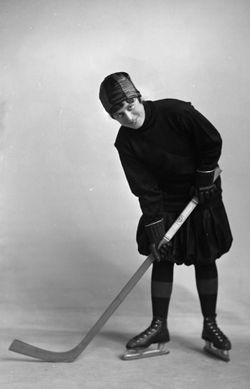
The Alerts became one of the leading women’s teams in Eastern Canada, playing opponents from communities including Cornwall, Montreal, Renfrew and Toronto. Contemporary accounts describe significant public interest in women’s hockey in Ottawa. A photograph of Ault from 1917 preserved by Library and Archives Canada shows one of the athletes who helped build that following. According to research published by the BYTOWN Museum Youth Council, the Alerts played before a crowd of approximately 2,000 spectators that year, wearing black and gold.
Ault developed a reputation as a dependable offensive player.
Her ability around the net eventually earned her the nickname that has followed her through hockey history: “Queen of the Ice.” The Hockey Hall of Fame’s historical material on the pioneers of women’s hockey identifies Ault as a consistent goal scorer and records that she was popularly known by that title.
The description was not simply a modern tribute attached to her career decades later. Contemporary reporting recognized her as one of the team’s notable players. A March 1922 Toronto newspaper account described Ault as “a real star” and reported that she had scored at least one goal in practically every game she had played.
Taking Women’s Hockey Across the Border
One of the most remarkable episodes of Ault’s career occurred in February 1917.
The Ottawa Alerts travelled to Pittsburgh to play the Pittsburgh Polar Maids in a three-game series. Historical research identifies the matchup as the first series between Canadian and American women’s hockey teams.
Ottawa swept the series.
The Alerts won the opening game 4–0 on February 26. They followed with a 5–1 victory the next evening. Eva Ault scored in that second game, joining Hazel Quinney, Edith Anderson and Beatrice Hagan among Ottawa’s goal scorers.
On February 28, Ottawa completed the sweep with a 3–1 victory.
The trip did not end there. On their journey back to Ottawa, the Alerts stopped in Toronto and played the Aura Lee team to a scoreless draw.
Viewed more than a century later, the Pittsburgh series is particularly significant. Canada-U.S. competition is now central to elite women’s hockey. In 1917, however, there was no established international women’s championship structure. Ault and her teammates were crossing the border and competing internationally decades before women’s hockey became an Olympic sport.
They were helping establish the precedent.
A Game Becoming Organized
Ault’s career also overlapped with another important development: the creation of a more formal structure for women’s hockey in Ontario.
In December 1922, representatives gathered in Toronto to establish the Ladies Ontario Hockey Association (LOHA). Eighteen teams initially joined the organization, including the Ottawa Alerts.
The creation of the association represented an important change. Women’s hockey was moving beyond loosely organized exhibitions and challenge matches toward schedules, playoffs, championships and formal administration.
The Alerts quickly demonstrated that they belonged among Ontario’s strongest teams.
During the 1923 championship series, Ottawa faced North Toronto. After the two-game, total-goal series, the Alerts emerged victorious and received the Dr. Lorne Robertson Trophy as Ontario champions.
Ault’s contribution to women’s hockey soon extended beyond playing.
In 1924, she served as a vice-president of the Ladies Ontario Hockey Association, placing her among the women involved in the administration of the developing game. Historical hockey records also identify her as serving in that role in 1925.
That part of her story is significant.
Ault was not only participating in women’s hockey. She was involved in helping support the organizational structure that allowed other women to participate.
More Than a Nickname
It can be tempting to view the title “Queen of the Ice” simply as a colourful nickname from another era.
But Ault’s career deserves to be considered in its historical context.
When she began playing with the Alerts, women did not have the pathways available to elite female hockey players today. There was no women’s professional league comparable to the modern game, no Olympic women’s hockey tournament and no established national women’s championship system resembling those that developed later.
What did exist were women willing to play.
They organized teams. They travelled. They competed for championships. They attracted spectators. They created associations. And, through their performances, they demonstrated that competitive hockey was not exclusively a men’s game.
Ault was part of that generation.
The Hockey Hall of Fame now includes her among the early trailblazers of women’s hockey, identifying her alongside other pioneers who helped establish the women’s game in Canada.
Life Beyond Competitive Hockey
Eva eventually married Ottawa athlete James Buels, who played football with the Ottawa Rough Riders. The couple did not have children. Available biographical records indicate that Eva did not pursue employment outside the home, but her involvement with skating continued after her competitive hockey years. She volunteered with Ottawa’s Minto Skating Club.
That connection kept her close to the ice long after the years when newspaper reporters had described her as one of Ottawa’s hockey stars.
Eva Catherine Buels died in 1984 at the age of 93. She was laid to rest at Beechwood Cemetery.
Remembering the “Queen of the Ice”
The hockey world Eva Ault knew would be almost unrecognizable today.
Women’s hockey is now played at the highest levels of international competition. Young girls can grow up watching women compete professionally and representing Canada before audiences of millions.
That progress did not begin recently.
Its foundations were laid by generations of players whose names are less familiar today: women who found ice time, formed teams, travelled to play opponents and built organizations when women’s competitive sport received considerably less recognition.
Eva Catherine Ault Buels was one of them.
In 1917, she travelled with her Ottawa teammates across an international border to compete against an American women’s team. By the early 1920s, newspapers were describing her as a star. As women’s hockey became more formally organized, she served as an executive in the provincial association governing the sport.
More than a century after she first took to the ice with the Ottawa Alerts, the nickname given to her seems particularly appropriate.
Eva Ault was Ottawa’s “Queen of the Ice.”
And from her resting place at Beechwood, her story remains part of the much larger story of the women who helped build hockey in Canada.