
Veterans and War Dead
Ensuring that the sacrifices of our Canadian Veterans and War Dead are not forgotten.
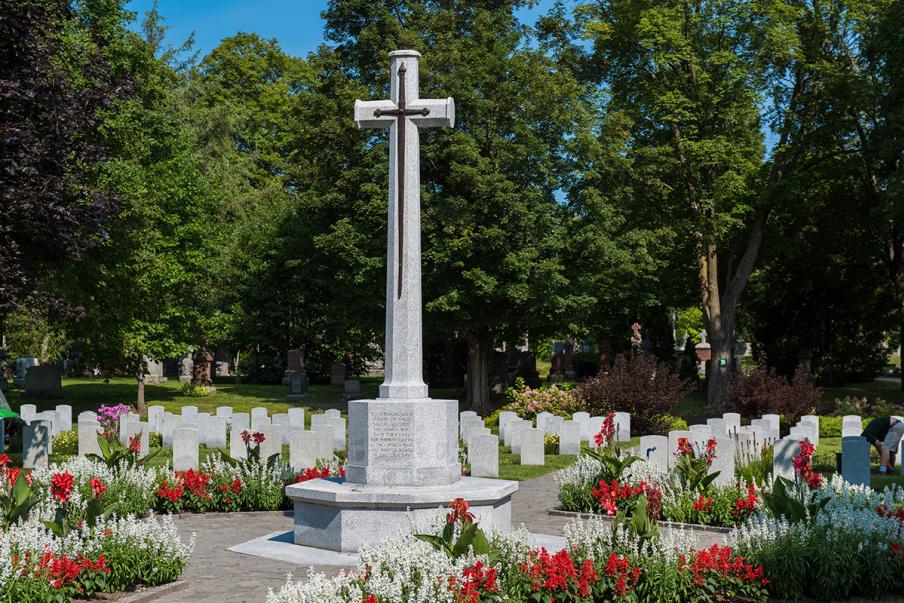
Beechwood has played a major role in ensuring that the sacrifices of our Canadian Veterans and War Dead are not forgotten. Beechwood’s Veterans and War Dead Section is the time-honoured final home of over 3,000 of our Canadian Veterans and War Dead.
The Commonwealth War Graves Commission (CWGC) is responsible for over 210 war graves from both world wars, located mostly in Sections 27 and 29. The CWGC was established in 1917. Its duties are to work and maintain the graves of the forces of the Commonwealth who died in the two World Wars, to build and maintain memorials to the dead whose graves are unknown, and to keep records and registers. The Canadian Agency of the Commission is responsible for fulfilling these tasks in North America. Veterans’ graves, those who served and survived the wars but were subsequently buried at the expense of Canada, are located mostly in Sections 19, 27 and 29, and are the responsibility of Veterans Affairs Canada.
At Beechwood, Veterans and War Dead from the Northwest Rebellion, the World Wars, the Korean conflict, United Nations Campaigns and other conflicts and humanitarian missions rest shoulder to shoulder beside the leaders they served, including Generals Henry Crerar, Andrew McNaughton and Charles Foulkes. In 1944, the Crown (Veterans Canada) purchased Section 27 where 2,400 hallowed graves fan out from the CWGC’s Cross of Sacrifice, a central feature of this section.
The Ottawa Cremation Memorial, located in Section 27, is a shelter in which the CWGC maintains bronze plaques commemorating Commonwealth war dead whose remains were cremated in North America and bronze plaques commemorating Dutch war dead whose remains were cremated in Canada.
For more information, visit:
Commonwealth War Graves Commission or Veterans Affairs Canada
For no-obligation inquiries, contact one of our Beechwood liaisons at Beechwood, Funeral, Cemetery, and Cremation Services:
Toll Free: 866-990-9530
Tel: 613-741-9530
Fax: 613-741-8584
Email: info@beechwoodottawa.ca
The Veterans section, also called the Field of Honour, is a part of the National Military Cemetery (NMC), and is reserved for Canadian Forces Veterans. It was purchased by the Crown in 1944, and is now overseen by Veterans Affairs Canada (VAC) and it contains over 2400 graves. While the majority of the graves are maintained by VAC, some are the responsibility of the Commonwealth War Graves Commission (CWGC). Two other smaller areas, in sections 19 and 29, are also overseen by the CWGC.
There are several interesting features in the Veterans section. The central feature is the Cross of Sacrifice, found in most Fields of Honour across the Commonwealth and war cemeteries around the world. Beechwood’s Cross of Sacrifice was erected by the Imperial War Graves Commission (now the CWGC) in 1959. It is one of 24 Crosses of Sacrifice located in Canada.
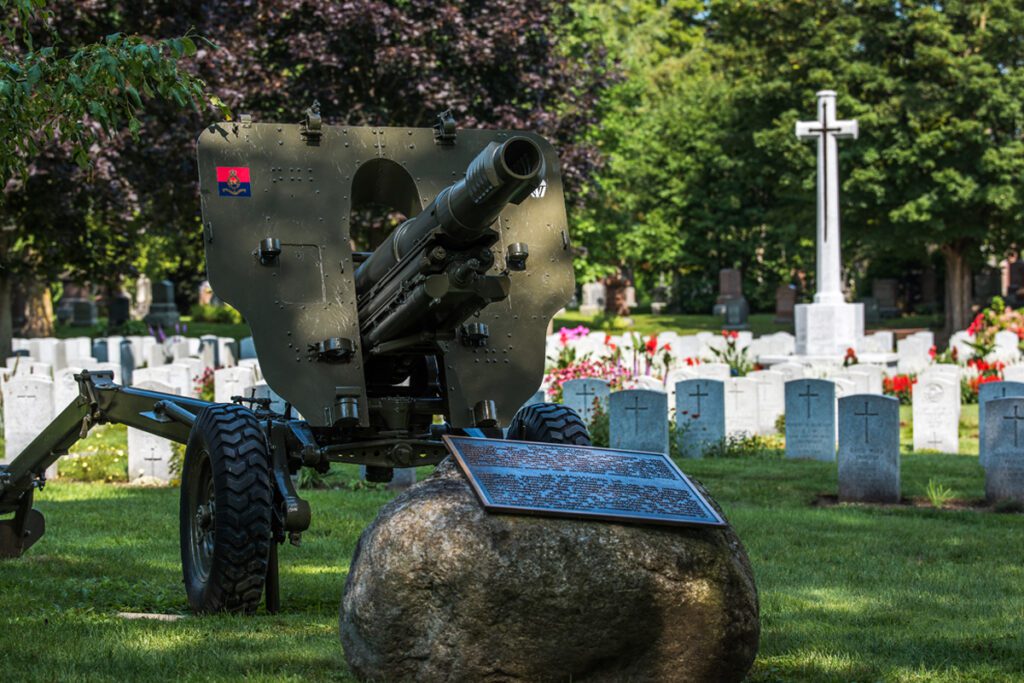
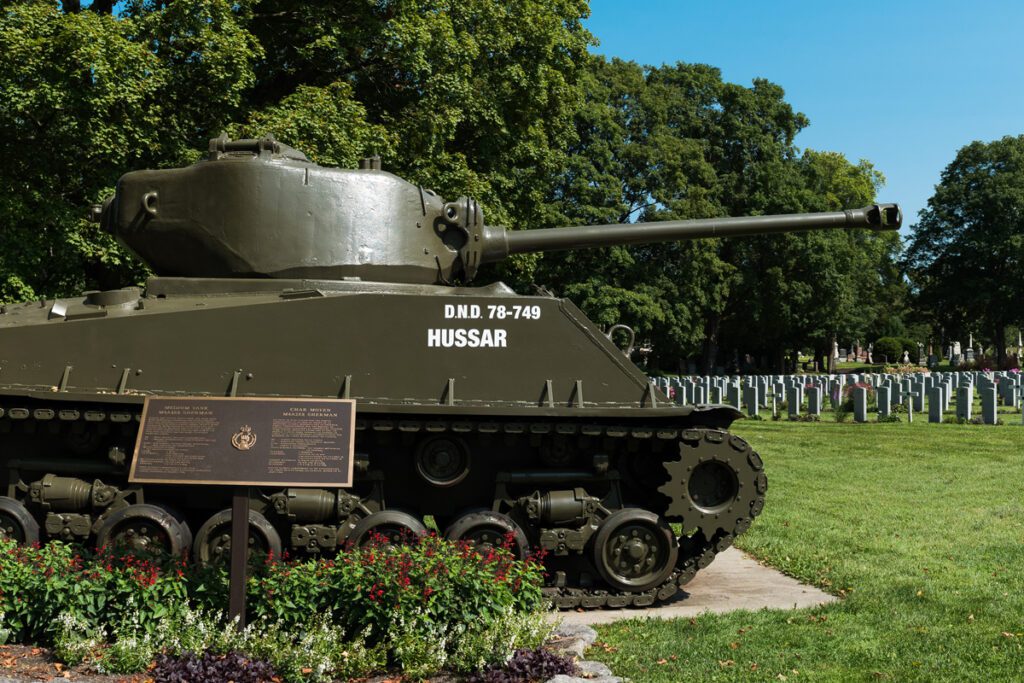
There are also several pieces of heavy artillery, including a howitzer, and most impressive, an M4A2 (76)W HVSS Sherman “Easy 8” tank. On October 7, 2004, the tank, which had stood outside the old Canadian War Museum for nearly 30 years, was ceremoniously moved to Beechwood. The tank was given the name “Hussar” after the 8th Canadian Hussars (Princess Louise’s) tank, which was also named “Hussar”.
Also located in this section is the Ottawa Cremation Memorial, a shelter in which the CWGC maintains bronze plaques commemorating Commonwealth war dead whose remains were cremated in North America and bronze plaques commemorating Dutch war dead whose remains were cremated in Canada.
Additional Facts:
- The CWGC commemorates those who died during the First and Second World Wars in service or of causes attributable to service, which includes individuals injured during the wars who were able to return home to Canada, only to succumb to their injuries at a later date.
- The reason there are fewer CWGC-maintained graves in North America than in Europe is due to the fact that the CWGC had a strict no-repatriation policy. Due to the massive numbers of war dead, the battlefield conditions in most areas of Europe, and the slow transportation methods available at the beginning of the 20th Century, it would have been impossible to transport all the dead back home. There was also a feeling that repatriation would conflict with the feeling of brotherhood that had developed between all serving ranks. The few that you do find in cemeteries like Beechwood either died during the war due to training accidents, or as a result of injuries sustained during combat.